

Both Idaho Prosperity Fund, associated with IACI, and Idaho Freedom PAC, associated with IFF, have released slates of endorsed candidates for the 2026 legislative primary. In 2024, I compared the two organizations to determine which got the most bang for its buck, so I figured I would come back and look at who they’re choosing to endorse this time around. I appreciate the opportunity to indulge in a little bit of nerdy numbers:
Since both IFF and IACI maintain legislative scorecards, I thought it would be interesting to see where endorsed incumbents land on these metrics. Of IFPAC’s nine endorsed incumbents, all but one are members of the Gang of 8 Caucus. The average IFF Freedom Index score among these nine is 95.6%, while the average Spending Index score is 96.3%. That makes sense.
Looking at challengers, the average Freedom Index score of the opponents of IFPAC-endorsed candidates is 54.6%, while the average Spending Index score is 20.4%. Again, this makes sense. IFPAC is clearly prioritizing incumbents who score highest on the Freedom and Spending Indices, while targeting those who score lowest.
Turning to IPF endorsements, the average IACI score for endorsed incumbents is 63, with a wide range—from Sens. Lori Den Hartog and Jim Woodward at 83 down to Rep. Joe Palmer at 37. Palmer is unopposed, in any case. IPF also endorsed Sens. Josh Keyser and Van Burtenshaw, who each scored 42, and Sen. Kelly Anthon at 46. Burtenshaw and Anthon are also unopposed, with the former chairing the Senate Resources & Environment Committee, while the latter is the president pro tempore. Keyser, meanwhile, is in a three-way race in District 20.
The average IACI score of incumbents facing IPF-endorsed challengers is 55.7, only slightly lower than the average for IPF-endorsed incumbents. These scores range from Sen. Dan Foreman, who is being challenged by Rep. McCann and scored just 33, to Sens. Josh Kohl and Glenneda Zuiderveld, who each scored 75. IPF nevertheless endorsed their respective challengers, Brent Reinke and Casey Swensen.
It seems that IACI/IPF is endorsing on something less substantial than their own scorecard this year. Perhaps this is a case where endorsements are more about who you dislike rather than who you like. The average Freedom Index score for incumbents with IPF-endorsed challengers is 90.2%. Flipping that calculation around, the average IACI score for incumbents with IFPAC-endorsed challengers is 65, which is ironically higher than the average score for IPF-endorsed incumbents.
Op-ed from Dorothy Moon
Idaho GOP chairwoman Dorothy Moon used her weekly column to push back on the notion among Democrats that we need to be more like blue states:
According to the Tax Foundation, Idaho ranks 9th in the nation for tax competitiveness—how attractive a state is for doing business. By contrast, our neighbors California, Oregon, and Washington rank 48th, 35th, and 45th, respectively.
Some on the other side might argue that this is a bad thing—that we should be taxed more, not less. After all, someone has to pay for all those government programs our friends on the other side want to fund. But what exactly are West Coast residents getting in return for those higher taxes?
Idaho enjoys a much lower cost of living than our neighbors to the west, along with much lower crime rates. Unemployment is also lower here—around 3.7%, compared to 4–5% on the West Coast. It’s no surprise that people are flocking to the Gem State while leaving states like California behind.
Chris Cargill lauds tax cuts
Chris Cargill, president of Mountain States Policy Center, explained how decreasing tax rates have led to more revenue for the government:
There’s an important distinction that often gets lost in tax debates. Government revenue isn’t determined by tax rates alone. It’s determined by tax rates and economic activity.
Idaho reduced the first part of that equation. But the second part—the size of the economy and the amount of taxable income—grew substantially.
More people moved to Idaho. More businesses expanded or relocated. Wages increased. Investment followed.
The result? A larger tax base—big enough to generate significantly more revenue even at lower rates.
This shouldn’t be controversial, but in policy debates, it often is.
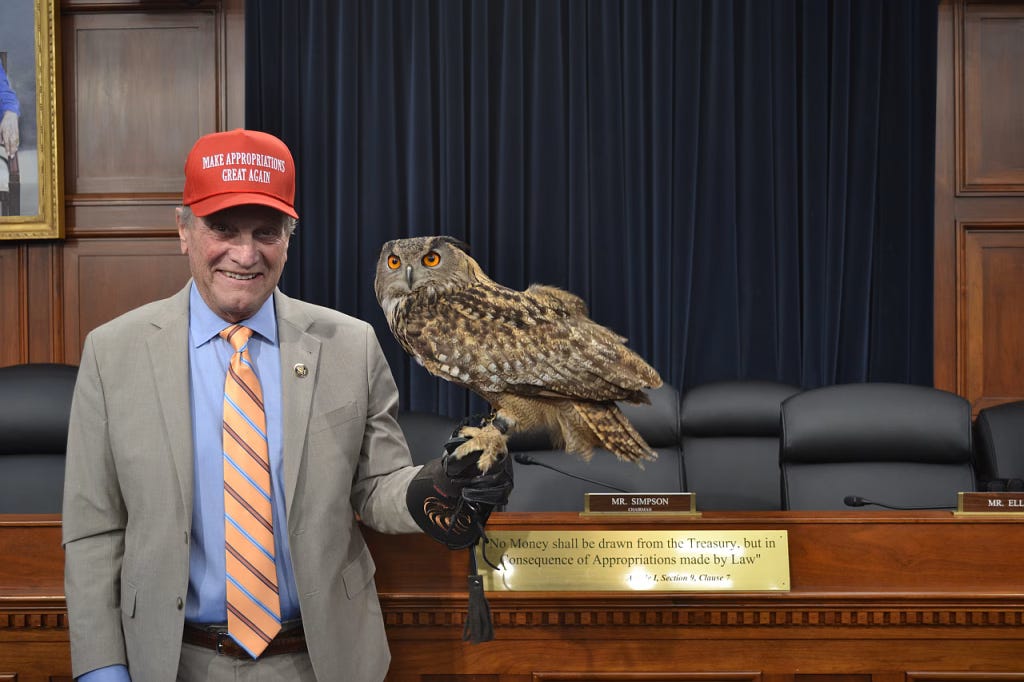
Birds invade Congress
Congressman Mike Simpson issued a press release explaining a birds of prey roundtable he hosted at the Capitol this week:
“Idaho has taken the lead in species recovery, particularly in preserving birds of prey, with many thanks to The Peregrine Fund. It has changed the paradigm of endangered species recovery and has continuously built on its successful track record of effective endangered species management. As a longtime advocate for preserving these beautiful birds, I was thrilled a fellow Idahoan, Chris Parish, could join for this informative and exciting briefing, and for numerous of my colleagues to see the beauty of exotic birds,” said Rep. Simpson.
Have you bookmarked Primary Pulse yet? It’s your one-stop shop for information about your Republican legislative primary candidates.
Thanks as always to sponsors New Saint Andrews College, Lynn Bradescu’s Boise Realty, Money Metals, and the iLuvIdaho Voter Guide. Thanks also to all of you for supporting this work!
I’m sorry but I got lost in the details of your analysis. I’m especially interested in my senator, Josh Keyser, and who is running against him and who is supporting them. Two competing “conservative” ratings is confusing, intentionally I think. But which one is honest and reliable?