

On Friday morning, the Joint Finance-Appropriations Committee (JFAC) voted to send ten maintenance budget bills to the House and Senate floors. These budgets incorporated not only Gov. Brad Little’s 3% holdbacks from last year, but also an additional 2% in cuts approved by JFAC the previous week.
Four senators expressed serious concern, not only about the cuts themselves but also about the way they were being implemented. Democrats Melissa Wintrow and Janie Ward-Engelking were joined by Republicans Kevin Cook and Jim Woodward in opposing many of the bills, but they were consistently outvoted. Cook began the day by debating against the entire maintenance budget process, urging the committee to scrap the agenda, restore last week’s cuts, and adjourn. Woodward then attempted to introduce a substitute motion that restored the additional 2% cuts to the first maintenance budget bill, but was ruled out of order by Co-chair Rep. Josh Tanner. Legislative Services Office (LSO) analyst Keith Bybee explained that JFAC had already voted to incorporate those cuts and could not undo that decision after the fact.
Sens. Cook, Wintrow, and Ward-Engelking each warned that this year’s cuts would “break” Idaho, citing examples of degradation, destruction, and even death that they claimed would occur if the cuts stood.
I was in the room for all three hours of the hearing, and joined Matt Edwards afterward to break it down:
Friday’s proceedings were a far cry from what happened in JFAC two years ago. On Groundhog Day 2024, nine Republicans (including Cook) and three Democrats used then-co-chair Wendy Horman’s absence as an opportunity to overturn the new maintenance budget process. In hindsight, this appeared to be part of a larger power struggle that led to the ouster of then-House Majority Leader Megan Blanksma and resulted in a victory for the new budget process.
This year, six members on the House side and six on the Senate side held the line throughout the hearing, ensuring that all ten maintenance budgets passed to the chamber floors.
This was an interesting reversal of the recent past, when conservative legislators were often derided for using procedural motions and lengthy debate to forestall votes they knew would not go their way. In the past two years, it has been moderates and Democrats resorting to futile attempts to delay the inevitable. While we’re not yet at a total conservative victory—just look at the way Rep. Heather Scott has had to struggle to get bills in House State Affairs even printed—we’ve come a long way in just a few years.
What strikes me most about rhetoric claiming that a 5% budget cut would be catastrophic is how it ignores the growth in spending over the past few years. According to the Legislature’s dashboard, base budgets—not counting enhancements, supplementals, and off-book spending—increased more than 36% over the past five years and more than 80% over the past decade.
The policy team at Idaho Freedom Foundation—especially Fred Birnbaum and new budget analyst Brett Farruggia—produced a series of infographics examining where the budget stands today, where it might be had the Legislature limited growth to inflation and population increases, and what options lawmakers have going forward. I spoke with Birnbaum and Farruggia about their work late last year:
There is no question that state government has steadily expanded, especially over the past five years. This graph shows how real per capita spending—a calculation accounting for both inflation and population growth—has increased dramatically in the first half of the 2020s:
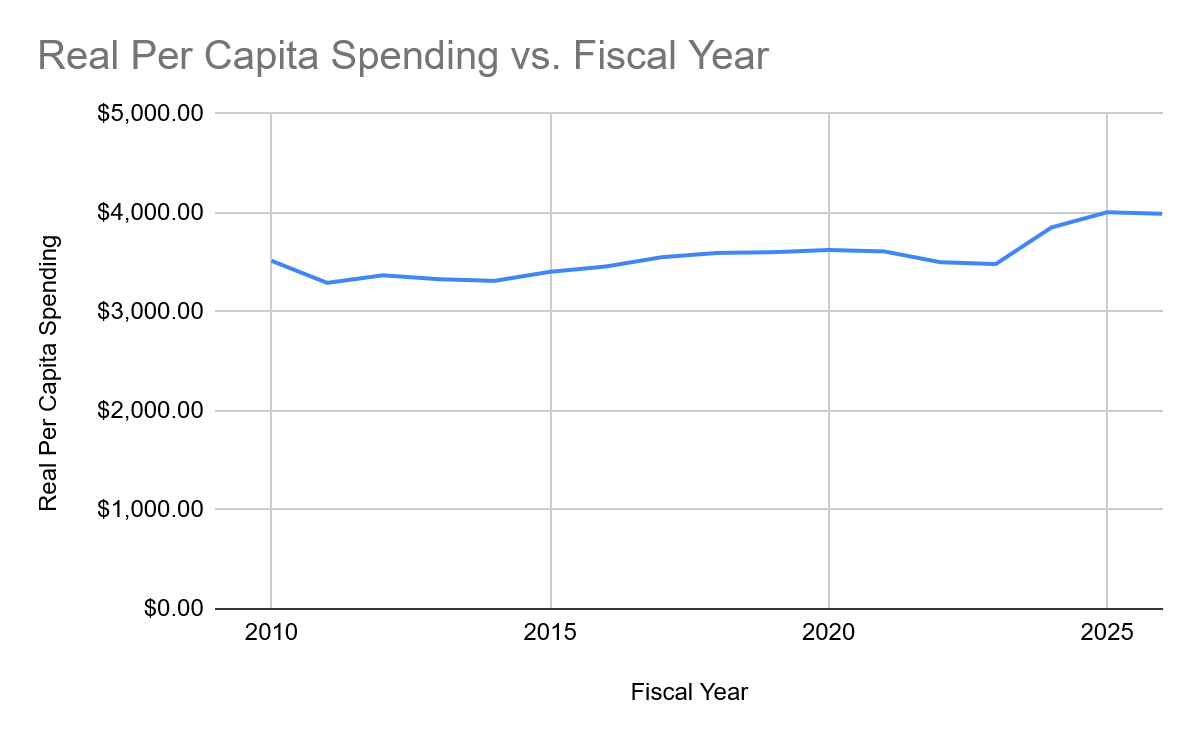
When legislators like Melissa Wintrow or Kevin Cook claim that budget cuts will be catastrophic, it is reasonable to ask whether we were in the midst of catastrophe when the base budget was $7.6 billion in Fiscal Year 2019 rather than $12.6 billion in FY2026. The next question is, “How much more do you think we should be spending?” If a 5% haircut would result in degradation, destruction, and even death, would a 5% increase improve the state further? How about 10%? 50%? Why not 100%? If the answer to every problem is a government program, why not confiscate everyone’s money and let supposedly wise central planners distribute it?
There is a fundamental divide in our body politic: between those who believe your money belongs to the government and those who believe it belongs to the people—from those who see society ordered top-down, and those who see it ordered bottom-up. I often remind my libertarian friends that we live in a society, but it’s just as easy for Republicans to forget that we are also meant to be a free people.
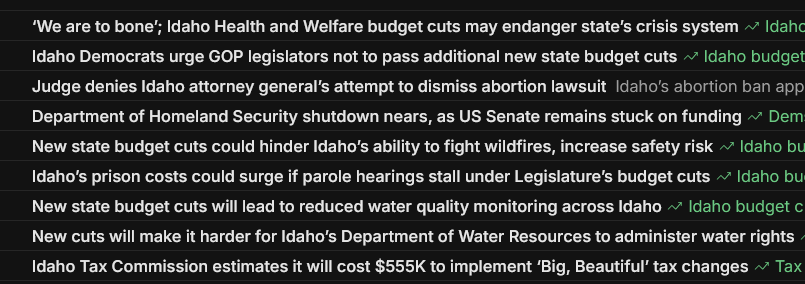
Our local media has certainly taken a side in this debate. Here is a screenshot from my RSS reader showing a selection of what the Idaho Capital Sun reported over the past 48 hours:
Democrats recently hosted a forum in the Capitol, inviting recipients of government welfare to share concerns about potentially losing some of that aid. Later, Idaho Reports, a program of taxpayer-funded Idaho Public Television, hosted four Medicaid recipients to voice their concerns.
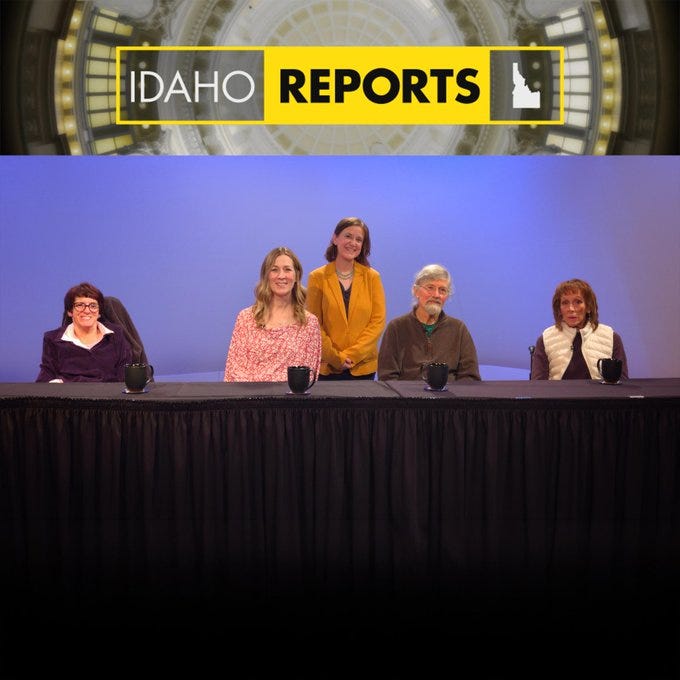
I have yet to see similar forums asking taxpayers—those who pay for all these programs—their thoughts on the proper level of government spending. Instead, the narrative comes entirely from those dependent on tax dollars. Watching yet another emotionally charged testimony, I was struck by how little gratitude was shown. Instead of recognizing that they benefit from a very generous society, the witnesses displayed endless entitlement, full of pride and devoid of humility.
Numerous political thinkers have noted the instability of a republic in which voters can use the ballot box to extract resources from fellow citizens. I wrote about this doom spiral last fall:
Yet any government welfare program inevitably changes incentives—especially once Americans lost their sense of shame in using them. Social Security led to Medicare and Medicaid, which led to Obamacare and Medicaid Expansion, with food stamps, Section 8 housing vouchers, and other taxpayer-funded programs along the way. Today we have an entire ecosystem of government welfare, along with a service industry dedicated to helping people extract as many benefits as possible.
Once you assume that government can solve all society’s problems, there is no limit to its growth. That’s why our Founders wisely imposed hard limits on the scope of government, and why we would be wise to maintain them.
Contrary to the histrionics at play in JFAC on Friday, there remains ample opportunity to ensure important programs are funded. As Rep. Steve Miller noted on Friday morning, these 5% base budget cuts are necessary targets, and it will be up to JFAC and the Legislature to tweak individual line items. If the juvenile drug treatment program highlighted by Sen. Wintrow or the parole program raised by Sen. Cook are vitally important, JFAC can authorize enhancement budgets while making up the difference elsewhere.
Former state senator and current candidate Scott Herndon explained it well in a Facebook post that I republished with permission:
Keep in mind though that these modest cuts come after state spending has still grown 60% in the last 6 years, and there is much more work to be done on the budgets for the remaining 2 months of this legislative session. Some of the cuts could be added back, and cuts could become more targeted, rather than across the board.
Having to reduce spending is an opportunity in which the legislature should really look for waste, inefficiencies and unnecessary government programs that are outside of the core mission of what we want our state’s government to accomplish.
Big spenders act as if money is infinite, and only conservative greed prevents government from creating a utopia. Fiscal conservatives recognize that money—like all resources—is finite, which means we must prioritize programs to fund and those to cut. These are the hard decisions we elected our lawmakers to make. JFAC was never meant to rubber-stamp agency spending. Our elected legislators are constitutionally mandated to produce a balanced budget each year, which requires making hard choices and prioritizing needs and wants.
Some programs may need more money. I believe the Attorney General’s office is doing vital work within the proper scope of government, so it should have sufficient resources to do its job. On the other hand, many government programs fall outside that scope and should be trimmed.
The elephant in the room remains Medicaid Expansion. Much of the outrage over provider rate cuts and reductions exists because lawmakers are afraid to touch Expansion. Yes, it was implemented by Idaho voters in 2018, but they went to the polls having been told it would max out at around $400 million. Now it exceeds $1.3 billion with no ceiling in sight.
Why protect a program that subsidizes able-bodied, working-age adults while cutting programs that help the most vulnerable? We can debate the size of welfare programs—or whether they should exist at all—but once you accept their existence and finite resources, we should prioritize those who truly need them. Medicaid Expansion distorts incentives for both employers and individuals, causing people to limit their potential for fear of losing benefits.
Now that 90,000 citizens are enrolled in Medicaid Expansion, repealing it would provoke wrath, and tears. This illustrates why government programs are hard to eliminate: every beneficiary who stands to lose gets amplified by politicians and reporters invested in continuation.
Will next year’s 5% budget cuts break our state? Hardly. Despite emotional outbursts over the past few weeks, these cuts barely return the base budget to FY2025 levels, much less earlier years before Idaho’s government expansion. They also don’t include upcoming enhancements or supplemental requests agencies will make to handle unexpected costs. Total appropriations for FY2027 will likely still exceed FY2026!
Yet it’s never enough for those who believe your money belongs to the government first.
It’s time for Republicans to act as the fiscal conservatives they claim to be, making hard decisions that return government to its proper role while being good stewards of taxpayers’ money. It’s time to remember the forgotten men and women upon whom all of this spending ultimately depends.
Budgeting ultimately comes down to three steps. First, how much money do we have? Second, what's our starting point for spending? Third, what needs to be plussed up from the starting point and what can be cut from the starting point? From these three sometimes follows a fourth -- do we need more money from raising taxes or are we in a position to cut taxes?
The real act of budgeting comes in step three, and it's the hardest, because it should force decisions about programs that are performing badly, are redundant, or are no longer needed. By putting in the hard work to find programs that should be repealed altogether or cut, resources are freed for higher priorities or even tax relief. Members of the legislature who identify these badly performing programs and succeed in their removal or diminution are the real heroes to be lauded.