

The Idaho State Gun
Idahoans will have a lot of choices on our ballots this year, from federal, statewide, and legislative candidates to county and local races, as well as questions involving abortion, drug policy, and whether English should be our official state language. But there is one question that is less consequential and more fun: choosing Idaho’s official state gun.
Placed on the ballot by House Bill 932, , which passed both chambers of the Legislature unanimously earlier this year, the question also has an obvious political benefit for Republicans in a midterm election that could see depressed turnout. On the one hand, it can be seen as a cynical political play; on the other, it’s harmless fun, so why not?
Your six options are:
Winchester Model 1894 rifle, chambered in .30-30 Winchester
Winchester Model 1873 rifle, chambered in .44-40 Winchester
Colt Single Action Army revolver, chambered in .45 Colt
M1 Garand rifle, chambered in .30-06 Springfield
Colt M1911 pistol, chambered in .45 ACP
Remington Model 700 rifle, chambered in .30-06 Springfield
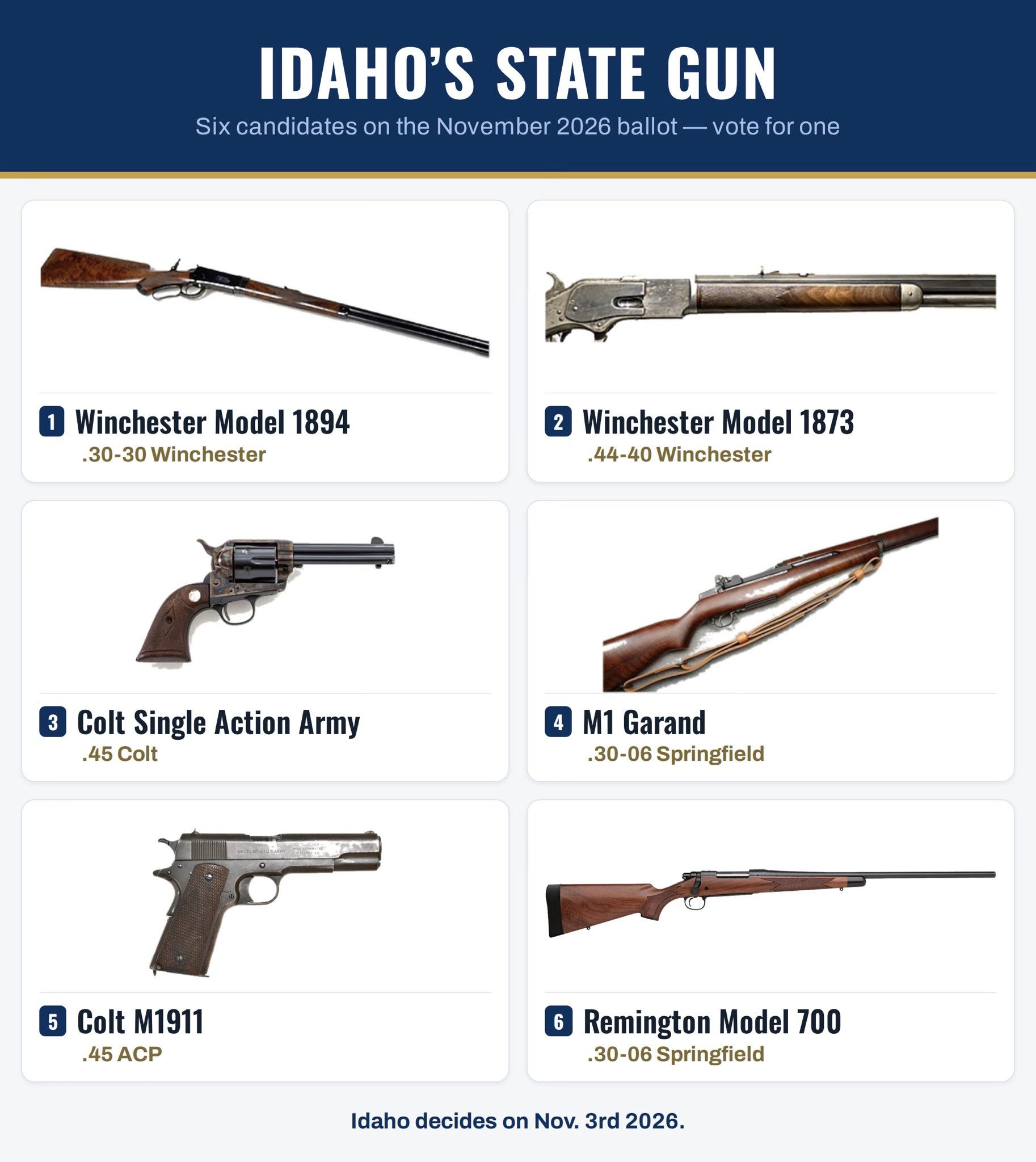
All of these are quintessentially American guns, but the real question voters must ask themselves is which one best represents Idaho.
The choices on the ballot span nearly a century of American history, from the Old West to World War II and beyond. Idaho’s history began earlier than that, as American Indian tribes, the Lewis and Clark expedition, fur trappers, missionaries, emigrants traveling the Oregon Trail, and prospectors searching for gold crisscrossed what would someday become the Gem State.
Idaho Territory was organized in 1863, and ten years later Winchester debuted its Model 1873 rifle. It was carried by miners, stockmen, lawmen, and even members of the Nez Perce during their attempted flight toward Montana and Canada in 1877.
The Colt Single Action Army revolver was also introduced in 1873 and quickly became established as the standard military sidearm of the late 19th century. When Wyatt Earp briefly served as a Kootenai County sheriff’s deputy in 1884, he might well have been carrying a Colt Peacemaker.
The Winchester Model 1894 was introduced four years after Idaho became a state, at a time when the Old West was rapidly transitioning into the 20th century. It became one of the best-selling rifles in American history and remains closely associated with the hunting tradition of the Mountain West.
The Colt M1911, designed by John Browning and adopted as the U.S. Army’s official sidearm in 1911, represents the rise of the American soldier throughout the 20th century. Young men from Idaho carried the 1911 onto European battlefields in two world wars, and it later became a standard for civilian gun owners as well.
Like the Colt 1911, the M1 Garand made its name on the battlefields of Europe. It was the standard infantry rifle for American soldiers in World War II and continued in that role during the Korean War. More than almost any other firearm, it remains associated with the American GI of the mid-20th century.
Finally, the Remington Model 700 was introduced in 1962 and remains one of the most recognizable bolt-action hunting rifles in America. It represents the modern hunting culture of the West and can surely be found in homes and pickup trucks throughout the state.
The six choices represent different eras: the territorial period, early statehood, the world wars, and modern times. All six are significant American firearms, but each tells a somewhat different Idaho story. The Winchester 1873 evokes territorial Idaho, while the Model 1894 and Remington 700 speak more to the hunting and rural culture that developed afterward. The M1911 and M1 Garand represent Idahoans’ participation in the great American conflicts of the 20th century.
So which gun best represents Idaho as a whole—from the world of mining camps, Indian wars, and ranching to rural homesteading, hunting, and the modern Idaho sportsman? I confess that after looking into the history, I find the Winchester 1873 especially compelling. The M1 Garand and 1911 are hard to compete with as iconic American firearms, and plenty of Idaho hunters probably have more personal attachment to a Model 700 or Winchester 1894. But if the question is not “Which gun is your favorite?” but rather “Which gun best symbolizes Idaho?” then our territorial history deserves serious consideration.
Ultimately, the voters will decide. Just remember what the question is asking before you fill in the bubble. Choosing a state gun is really about choosing which chapter of our history we most want to symbolize, so choose wisely.
Feature image by Hi-Lux Optics.
Dorothy Moon explains the big bucks behind Prop 1
If you’re reading this, then you already know why you should vote no on Proposition 1. This radical initiative would eliminate Idaho’s laws protecting unborn babies, introduce vague terminology regarding “viability” that could potentially allow abortions in the third trimester, no questions asked, and remove legal requirements for parental consent for minor girls. It’s too extreme for Idaho, and I believe Idahoans will vote no on November 3rd.
Today I’d like to focus on the people and organizations spending millions of dollars to convince you to vote yes.
The euphemistically named Idahoans United for Women and Families, the organization behind Prop 1 and the effort to legalize abortion in Idaho, has raised nearly $5 million since launching the initiative campaign in late 2024. Of that, $1.3 million was reported this week alone from five out-of-state donors.
Exactly half of that amount came from Government That Works PAC, a D.C.-based group that is also bankrolling Democratic candidate James Talarico’s campaign in Texas. Talarico, as you know, supports a radical agenda, from transitioning children to high taxes and regulations and even opposition to eating meat. Are these the values we want here in Idaho?
Press releases
In searching for a thumbnail for today’s post, I came across this great article about the history of the Winchester 1873 model rifle, which will be my choice for our state gun:
The Winchester 1873 isn’t the most accurate nor does it fire the strongest cartridges. Actually, when you look down at the chamber, you’ll notice the face of the bolt doesn’t even quite reach the mouth of the chamber, leaving a visible gap for the rim.
What it does have, that many other rifles at the time of its creation did not, was repeating firepower of great speed. You can put more than a dozen rounds down range in less than a minute, and it has a magazine that can hold those rounds. While that doesn’t sound too fancy nowadays, you have to consider that this rifle is not far off from being a century and a half old in design.
Yet it doesn’t look a day over 44.
Video of the day
Since we’re talking about classic American firearms, here is guntuber and future congressman Brandon Herrera testing the guns of the video game Red Dead Redemption 2:
I’m nearly finished with the commodities commissions at the state agency hub on Idaho Insider. Some of them have extremely sparse web presences, but I’m collecting as much information as I can. Check it out!
Have you been catching the Daily Minute? It’s an exclusive publication of the Gem State Chronicle summing up what you need to know, published most every weekday. You can subscribe on YouTube, Facebook, X, and even TikTok!
As always, thank you to sponsors Lynn Bradescu’s Boise Realty, Money Metals, and New Saint Andrews College. Thank you also to all the paid subscribers who make it possible for me to do what I do, as well as all the readers who are constantly encouraging me to keep it up. I appreciate you all!