

Most conservative political activists in Idaho have heard of the Idaho Association of Commerce & Industry (IACI). For many, it serves as a synecdoche for a moderate/progressive/globalist political establishment—an arm of the World Economic Forum, intent on subsuming the Gem State into Klaus Schwab’s dystopian vision. Support from IACI marks a candidate for suspicion at best, while opposition becomes a badge of honor.
Republicans have long supported private enterprise. Great presidents such as Calvin Coolidge and Ronald Reagan were champions of the free market who opposed central planning and government regulation, but do today’s businesses support conservative values? I think the answer is clearly “no”. In last year’s election cycle, IACI’s PAC, the Idaho Prosperity Fund, endorsed numerous moderate Republicans, both incumbents and challengers, as well as Democrats. Does such an organization deserve your loyalty and support?
I’ve written about IACI numerous times since I started this newsletter nearly four years ago. In “The IACI Uniparty” in December 2023, I wrote:
To put it another way, IACI would rather have a Democrat who supports abortion until birth, radical racial and gender curricula in schools, and irreversible drugs and surgeries for children than a Republican who votes against more tax breaks and subsidies for its member businesses. So long as the money keeps flowing, IACI is happy.
This is why so many conservatives have become disillusioned with big corporations and their lobbying associations. IACI is happy to support radically leftist politicians and policies so long as its subsidies and tax breaks are protected. Over the past decade, the same corporations that Republicans once championed as defenders of the free market have not only lobbied for tax breaks, subsidies, and regulations that hinder competition—they have also used their influence to promote radical racial and sexual ideologies.
Each legislative session, IACI highlights a couple dozen bills that it considers important to its member businesses. Some it supports, others it opposes, and a few it takes no position on. Some of these positions make sense, such as legislation affecting subsidies or regulations. Others are more puzzling. For example, in 2024, IACI opposed legislation to prohibit government agencies from imposing mask mandates, as well as a bill to crack down on “debanking” people over their political views. It supported legislation granting Bayer immunity from lawsuits related to pesticides and herbicides, as well as expanding the budget of the Workforce Development Council.
I created a quiz last year to see how you would rate on IACI’s 2024 scorecard. Click here to try it yourself.
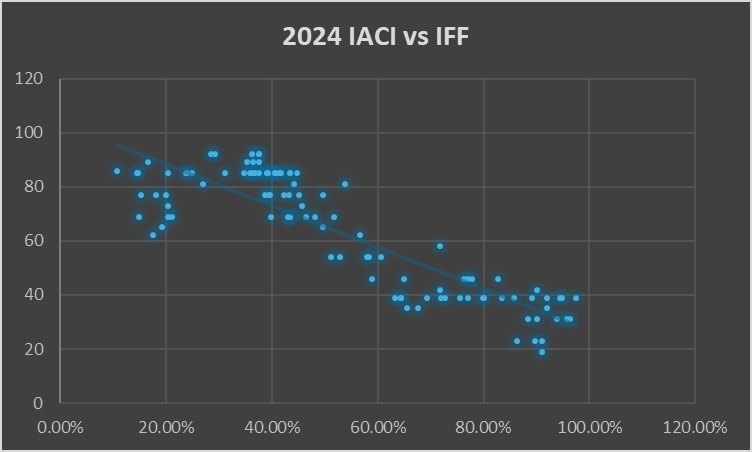
In 2024, IACI scores were negatively correlated with the Idaho Freedom Foundation (IFF) Freedom Index by an astounding –0.87. That means that the higher a lawmaker scored on one system, the lower they scored on the other. While IFF publishes the metrics it uses in scoring bills, IACI’s methodology remains a secret.
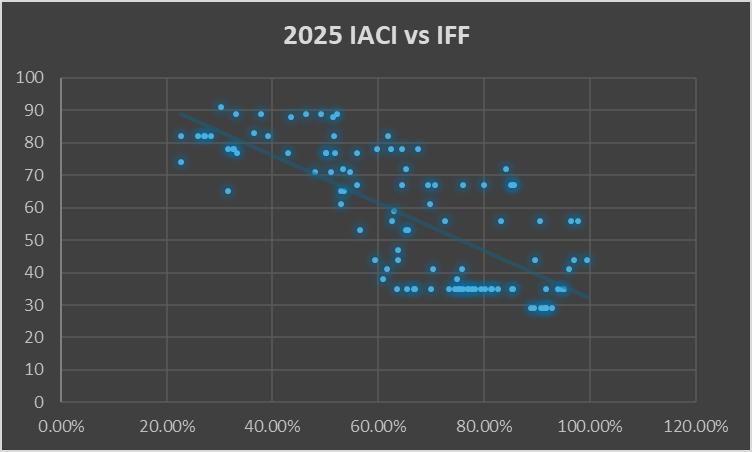
The 2025 session saw a few changes. The average Freedom Index score in the Legislature rose from 52.6% to 65.6%, while the average IACI score dropped from 63.2 to 57.3. The previous negative correlation fell to –0.74, which while still significant, shows a clear change in the tides.
IACI’s 2025 scorecard lists 65 bills, of which 39 factored into legislator scores. The organization opposed efforts to put guardrails on Medicaid Expansion, as well as bills ensuring no illegal aliens received welfare, limiting the governor’s authority to declare emergencies, establishing the DOGE Task Force, and passing the Medical Freedom Act. It supported bills including income tax cuts and exemptions for certain military pensions, property tax relief, and the addition of an anti-SLAPP provision to state law.
In all, IACI opposed and scored 30 bills, compared to only nine it supported and scored. Six of the nine it supported were signed into law, compared to just three of the 30 it opposed. It’s clear that while IACI’s influence over legislation diminished in 2025, which saw more conservative lawmakers take office than ever before, it still remains a force in Idaho politics.
Sen. Glenneda Zuiderveld published a Substack article yesterday that cast IACI as the globalist Goliath against which grassroots conservative Davids must constantly battle:
IACI likes to call itself a “business association.” On the surface, that sounds harmless, even noble. We all support business. I certainly do. I fight every day for local, family-run operations that are being buried under property taxes, fees, regulations, and inflation.
But IACI is no longer a small-business advocate.
Over time, it has evolved into a corporate policy engine tied to global economics, not local commerce. It represents massive interests—healthcare conglomerates, tech giants, utilities, industrial agriculture, developers, insurers, and multinational corporations.
I would take it a step further and say that the biggest way IACI influences policy is not even at the legislative level. Despite its lobbying and electioneering via the Idaho Prosperity Fund, IACI holds the biggest seat at the table when it comes to how Gov. Brad Little and directors of executive agencies implement policy in Idaho.
After all, Little once served as chairman of IACI’s board, and the Idaho Prosperity Fund endorsed him in the three-way gubernatorial race in 2018. He often speaks at IACI events, and members have donated hundreds of thousands of dollars to his campaigns and associated PACs. The business owners who make up IACI are Little’s colleagues, friends, and allies. When he looks around for advice on which direction to take Idaho, these are the people he sees.
So who, then, is IACI? Alex LaBeau, the organization’s president for nearly two decades, claims that half of Idaho’s population is employed by IACI member companies. While there’s no official list of member businesses, the organization’s massive board of directors gives us some clues:
Alaska Airlines
Altria Client Services
Amalgamated Sugar Company
Amazon
AT&T Services
Avista
Ball Ventures LLC
Basic American Foods
Bayer US
Blue Cross of Idaho
Boise Cascade Company
Chobani Idaho Inc.
Clearwater Paper Corp.
Glanbia Nutritionals
Hecla Mining Company
HP
Idaho Central Credit Union
Idaho Forest Group
Idaho Materials & Construction, A CRH Company
Idaho Power Company
Idahoan Foods, LLC
Intermountain Gas Company
J.R. Simplot Company
Lactalis American Group
Lamb Weston
LS Power
Lumen
McCain Foods USA
Melaleuca
META
Micron Technology
Molina Health Care
Mountain View Hospital
PacificSource Health Plans
Perpetua Resources
PotlatchDeltic Corp.
Regence Blue Shield of Idaho
Saint Alphonsus Health System
Schweitzer Engineering Labs
SelectHealth
St. Luke’s Health System
Syringa Network
Union Pacific Railroad
US Bank of Idaho
Wada Farms
Wells Fargo Bank
Western Governors University
Western States Equipment Co.
There is significant overlap between IACI member businesses and state government. Five corporations on IACI’s board also have representation on the Workforce Development Council, which oversees the Launch Grant, among other projects:
Amalgamated Sugar
Chobani
Idaho Central Credit Union
Idaho Forest Group
Idaho Power
It’s not as simple as saying IACI represents corporate interests against grassroots Idahoans. If LaBeau is correct, 50% of Idahoans work for these companies. IACI would argue that it represents those workers—the fathers and mothers putting food on their families’ tables.
But do these companies truly represent Idaho’s people, or are they just cogs in a machine that benefits shareholders, CEOs, and a globalist agenda? Earlier this year, I asked whether it is really true that “What’s good for Micron is good for Idaho”:
Micron was founded in Boise in 1978 and received early funding from J.R. Simplot. However, when the company went public in 1984, it incorporated in Delaware to take advantage of that state’s favorable business laws. Despite maintaining its headquarters and a major presence in Boise, Micron is now a multinational corporation. Idaho is simply one location among many across the globe. What connection does Micron still have to Idaho beyond nostalgia?
When a company no longer feels any loyalty to the American people, its only loyalty becomes to its shareholders, which means the bottom line above all else. What fiscal argument can be made against Micron increasing profits by outsourcing or offshoring?
That’s the heart of the problem. IACI might represent Idaho workers on paper, but its actions—as seen in lobbying and electioneering—tell a different story. Outsourcing and offshoring may increase a company’s bottom line, but it doesn’t help the workers laid off in the process. Expanding the guest worker program to bring in more foreign employees for dairies and potato farms might lower costs for milk and fries, but it doesn’t help young people who lose access to entry-level jobs. Opposing restrictions on internet pornography might help tech companies’ profits, but it harms children and families.
These companies employ tens of thousands of Idahoans, but they would lay them off without hesitation if it meant increasing profits. Many large corporations hold a metaphorical gun to taxpayers’ heads, demanding tax breaks and subsidies to stay in the state. Risks are socialized while profits are privatized. Programs like the Launch Grant shift training costs for new employees onto taxpayers.
IACI maintains a complex relationship with Idaho government and taxpayers. Its member businesses employ thousands and provide essential services, yet the organization has clearly grown beyond simply advocating for business interests.
As we approach the 2026 legislative session and primary season, IACI will be out in full force promoting its policies and candidates. Be discerning. Just because IACI supports something doesn’t make it inherently bad. It’s fair to ask, however, whether it is acting on behalf of Idaho workers, or shareholders, multinational corporations, and a globalist agenda at odds with the traditional values most Idahoans still cherish.
The 2024 primary elections, followed by the 2025 legislative session, show that the IACI Goliath is not all-powerful. It will continue to advocate for its values, but the grassroots people of Idaho—who still believe in faith, family, and freedom—can advocate for ours as well.
Sharp analysis, Brian. IACI's roster—Amalgamated Sugar, J.R. Simplot, Lamb Weston, McCain Foods, Wada Farms, Glanbia, and kin—exemplifies crony capitalism run amok, gorging on federal handouts while foisting a deracinated globalism that undermines Idaho's bedrock values. The numbers lay it bare: Idaho's ag sector hauled in $3.03 billion in commodity subsidies from 1995-2024, with Wada Farms pocketing $9.44 million; Lamb Weston snagged $4.95 million in 2023 state tax credits; McCain landed $6.9 million in USDA grants for "sustainable" potato schemes; Glanbia grabbed $3.125 million for emissions gimmicks; Amalgamated thrives on USDA sugar loans worth hundreds of millions; and Simplot's raked in over $2 million annually in state aid plus federal perks.
But these distortions—bloated workforces, suppressed wages, and offshored jobs—stem straight from easy debt access, turning these outfits into quasi-government appendages rather than free-market players. Lamb Weston's net debt-to-equity clocks in at a staggering 223%, Glanbia's net debt hits $650 million with $1.3 billion in committed facilities, and the rest float on fiat-fueled leverage that props up inefficiency. Farm bosses have saturated Idaho with cheap Mexican labor—89% of dairy hands foreign-born, mostly undocumented Mexicans dominating 78-90% of the slots—while Boomers cashed out our English heritage for quick bucks. This betrayal guarantees implosion: subsidies fade, debt pyramids topple, and these sham corps crumble with the rest of America's fraud factories.
That said, we haven't seen the gut-wrenching devastation here that plagued places like Detroit, where auto giants offshored factories to Mexico under NAFTA's umbrella, lured by Mexican government sweeteners like 50% import duty discounts, freight concessions, and duty-free inputs—subsidies that seeded their own destruction by hollowing out the Rust Belt and shipping jobs south. In Idaho, the physical tether of ag and mining industries—rooted in land, soil, and resources—forces much of that debt and subsidy cash to convert into tangible capital investments right here or nearby, like the $3 million federal boost for the dairy-anchored Idaho CAFE facility near Rupert, or Chobani's $500 million Twin Falls expansion, pumping upgrades into local infrastructure rather than vanishing overseas. At least the fiat flows build something enduring in the Gem State before the inevitable rot sets in.
Worse, they're not even geared toward real production anymore, but infested with Social Justice Warriors converging them into woke husks. As Vox Day nails in "Corporate Cancer," SJW infiltration rots companies from the inside, prioritizing virtue signals over profits and driving away talent—costing billions and sealing their doom. Idaho will thrive without these debt-warped leeches, reclaiming space for genuine enterprises rooted in faith and freedom.
They're modern Pharisees, hawking souls for scraps. Matthew 16:26 rings true: "For what shall it profit a man, if he shall gain the whole world, and lose his own soul?"