

Welfare and Electoral Fraud are Real
There are several assumptions built into our current system of government and social services. With regard to welfare, we are asked to assume that benefits are reserved for the truly needy—vulnerable adults, children, and people who otherwise would not survive without government assistance. With regard to our republican system of government, we are asked to assume that each ballot counted corresponds to an American citizen who is registered to vote at his or her real home and who knowingly cast that ballot.
When people subvert these assumptions, we rightfully lose faith in these systems. Why should we tolerate our tax dollars going to fraudsters instead of the truly needy? How can we trust the outcomes of elections when noncitizens cast ballots that end up mingled with legitimate votes, or when we can’t be sure that mail-in ballots actually originated with real voters?
The way to restore trust in these institutions is to crack down hard on those who would abuse that trust. While proving crimes can be difficult, it is necessary, despite claims from some on the left that these things simply don’t happen.
Last Saturday, Attorney General Raúl Labrador announced that a Bonneville County woman had been sentenced for fraud involving Medicaid:
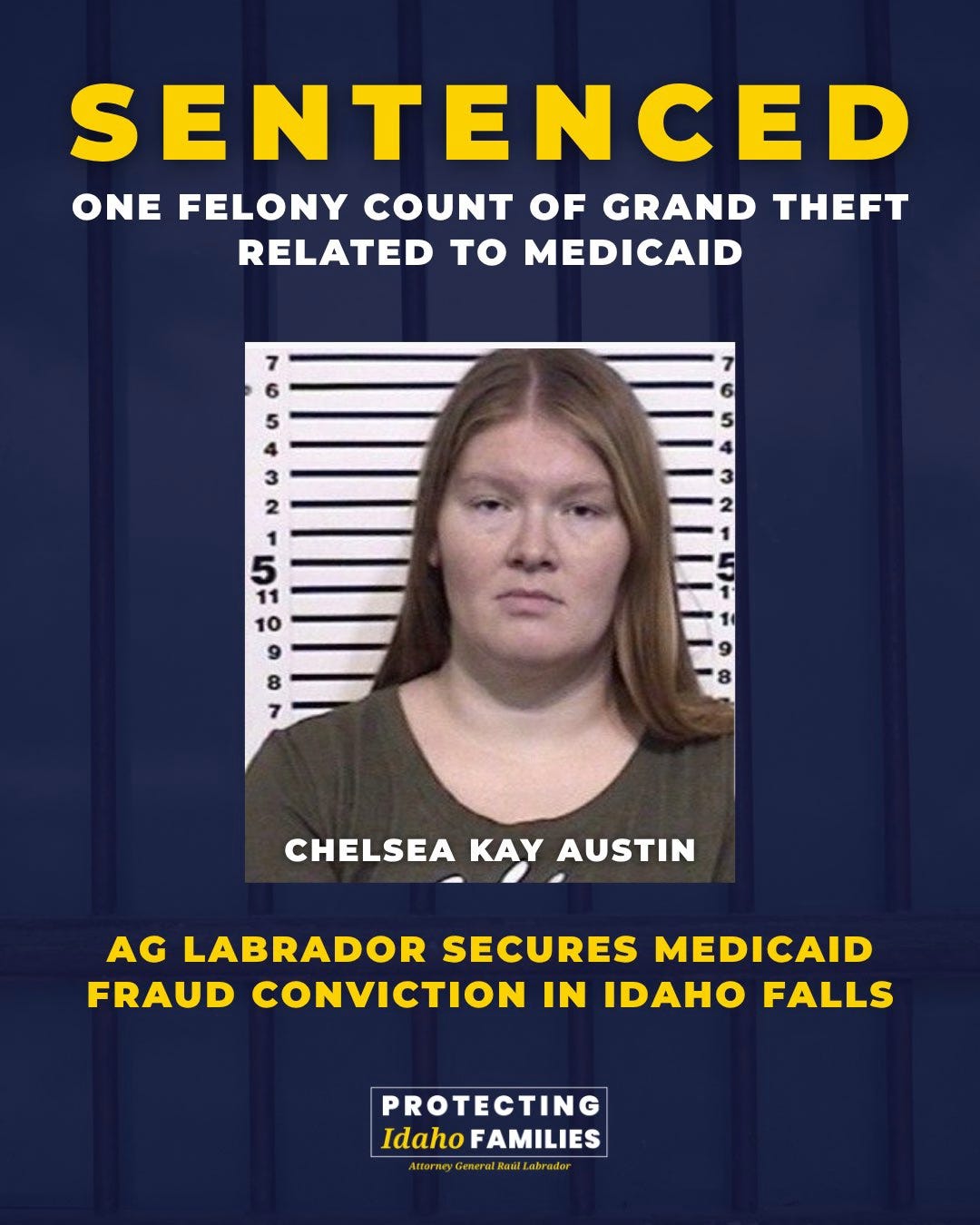
According to Bonneville County iCourt records, Chelsea Kay Austin pleaded guilty to felony grand theft stemming from an incident in 2024, while another charge of abuse or neglect of a vulnerable adult was dismissed. The judge sentenced Austin to a total of five years in prison but suspended the sentence and placed her on a one-year retained-jurisdiction program, after which the court can determine whether she will be released on probation or sent to prison. The case was prosecuted by attorneys from the attorney general’s office, but the probable-cause affidavit was sealed when the case was filed, so the public court record does not explain exactly what Austin did.
Just today, Vice President J.D. Vance announced that his fraud task force had recovered $2.2 billion in Obamacare fraud, which in some cases involved brokers or providers creating fictitious people and using them to claim various welfare benefits. The lesson here is that if there is an opportunity to steal from the taxpayer, a lot of people will take it, and simply giving beneficiaries the benefit of the doubt is extremely foolish.
That goes for election integrity as well. The late Scott Adams had an adage that if cheating is easy to do and hard to detect, then it is a certainty that people will cheat. The prize for cheating welfare is money, while the prize for cheating elections is political power.
Last week, a federal grand jury indicted Fredy Avila Gomez on a host of charges, including wire fraud, theft of government funds, false statement of citizenship in order to vote, voting by an alien, and false statement in a passport application. U.S. Attorney Bart Davis alleges that Gomez used fraudulent citizenship documents to vote, acquire Medicaid benefits, and purchase a firearm. According to prosecutors, Gomez was an illegal alien who not only voted illegally but also defrauded American taxpayers through healthcare benefits over the course of nearly ten years.
A republican system of government only works if the people trust in its integrity, and a welfare system only works if it is aggressively policed to crack down on fraud. That requires elected officials who actually want to crack down on fraud, which is a reminder that elections matter—it is how we determine who watches over these systems.
We are in a much better position today with President Trump, Vice President Vance, and Attorney General Labrador than we were five years ago. Yet it requires eternal vigilance: keep the pressure on our elected representatives to root out fraud, waste, and abuse, and continue reforming these systems to make them stronger, more resilient, and more resistant to exploitation—and, in the case of welfare, eventually reduce or eliminate them in order to restore incentives to work and help our fellow man rather than continue extracting money from the taxpayer.
Feature image created with Microsoft Copilot.
Video of the day
Lomez (minus Rufo today, apparently) interviews investigative reporter Brian Chau about the coordinated narrative regarding the potential threat of artificial intelligence:
Have you been catching the Daily Minute? It’s an exclusive publication of the Gem State Chronicle summing up what you need to know, published most every weekday. You can subscribe on YouTube, Facebook, X, and even TikTok!
As always, thank you to sponsors Lynn Bradescu’s Boise Realty, Money Metals, and New Saint Andrews College. Thank you also to all the paid subscribers who make it possible for me to do what I do, as well as all the readers who are constantly encouraging me to keep it up. I appreciate you all!