

Legislative Wins Above Replacement
If you’re trying to put together a championship baseball team, how do you evaluate potential players and decide who is worth investing your limited resources? In the old days, you picked a few statistics, such as batting average, hits, and home runs for position players, or strikeouts, earned run average (ERA), or wins for pitchers. This seemed to work for a long while, but Major League Baseball eventually reached a point where those stats had become ends unto themselves, with the real goal—winning games and championships—secondary at best.
In the 1980s, statistician Bill James began developing the idea of a “replacement player”—a generic baseline by which to judge real players. A replacement player isn’t a random person off the street who has never played the game; rather, it is someone a team manager could expect to get on short notice, such as an out-of-work veteran or a minor leaguer. Other nerds expanded on the concept through the 1990s and 2000s, creating the field of “sabermetrics,” and by 2008, baseball media had settled upon a calculation called WAR, or Wins Above Replacement.
The idea behind WAR is to take everything a player does—how often he gets on base, how many runs he generates, how well he plays the field, or—in the case of pitchers—how well he keeps batters off base—and combine that into the answer to a single question: how many more wins does this player generate for the team compared to a replacement player?
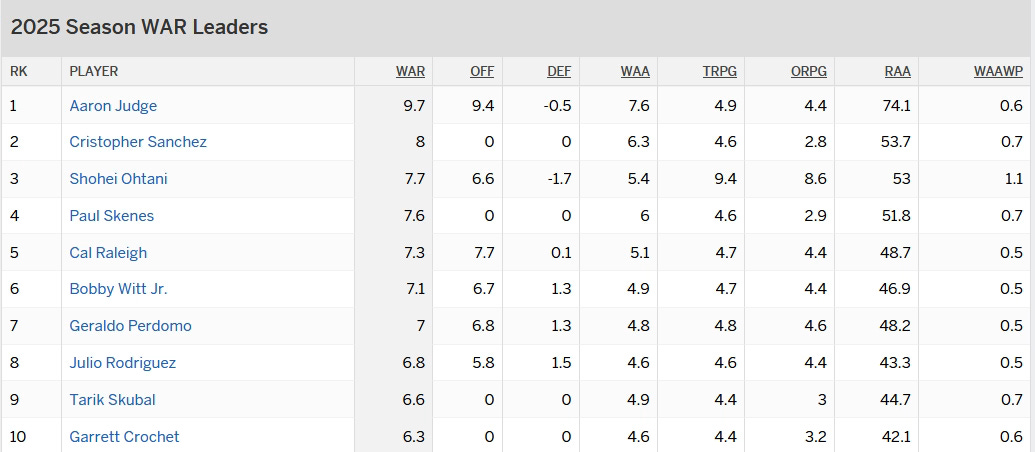
WAR gives managers, executives, sportswriters, and fans a coherent framework with which to compare players. According to ESPN, the highest WAR in 2025 came from New York Yankees outfielder Aaron Judge at 9.7. That means he accounted for nearly ten more wins than the Yankees would have had if his position had been played by a generic Major League replacement. Note that his defensive WAR is negative, meaning a replacement player would likely have been better in the outfield, but Judge’s offensive output was so incredible that he still led the league in the overall statistic.
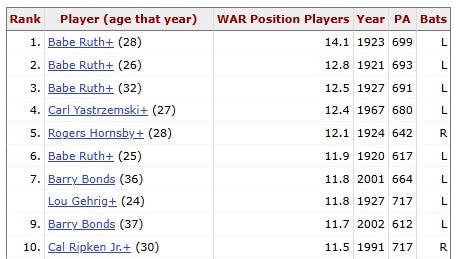
WAR also allows baseball geeks to compare players from different eras. According to baseball-reference.com, the highest WAR ever recorded in a single season was Babe Ruth’s 14.1 in 1923. Incidentally, Ruth also holds the 2nd- and 3rd-highest single-season WAR totals, not to mention the 6th, 13th, 28th, 45th, and 50th. Obviously, nobody ever needed sabermetrics to understand that Babe Ruth was one of the greatest baseball players in history, but it helps to quantify it.
Why am I writing about nerdy baseball statistics on a website devoted to Idaho politics? Because I have long believed we need the equivalent of WAR for legislative candidates.
There have been many attempts to quantify the value of a legislator with regard to a particular ideology or agenda. Many organizations, including the Idaho Association of Commerce & Industry (IACI), the American Conservative Union (ACU/CPAC), the Institute for Legislative Analysis (ILA), and others publish scorecards showing how lawmakers vote on each organization’s priorities. The Idaho Freedom Foundation’s (IFF) Freedom Index is perhaps the gold standard of scorecards because its analysts rate hundreds of bills each session, rather than a small handful that are directly related to specific priorities.
Former IFF president Wayne Hoffman explained the Freedom Index in a 2022 post:
The Freedom Index solves the mystery. The Freedom Index doesn’t ask whether a new program, government function, or restriction on liberty is good or bad. It just evaluates if the bill creates a new program, government function, or restriction on liberty. Every bill that was ever introduced in any lawmaking body is argued to be “good” by its supporters. Legislators will often cling to these positive narratives in order to justify the expansion of government. Whether a proposal is deemed good is not of interest to us. We’re only interested in its impact on a free society.
I believe scorecards can be a valuable tool for voters to evaluate their lawmakers, which is why I created Scorecard Explorer at the Gem State Chronicle. However, scorecards only tell a small part of the story when it comes to the job of serving in the Idaho Legislature.
Voting is easy. All it takes is speaking the words “aye” or “nay” when the secretary calls your name. Members of the House don’t even have to speak—they just press a green or red button on their desk phone. A legislator could score 100% on any given scorecard simply by showing up each day and voting exactly how that organization wants them to. I believe that voting is just the beginning of being a good legislator—you could say that someone who votes right is your replacement-level lawmaker.
Over the past few years, I’ve had a somewhat front-row seat to the legislative process and have seen how difficult it can be to turn an idea into law. Legislation must run a tough gauntlet, starting with being drafted by Legislative Services Office personnel, making it through a print hearing, then a committee hearing, then a floor vote, then another committee hearing, then another floor vote, then finally receiving the governor’s signature. An ideal conservative legislator must therefore not only vote right on the issues, but must also have the ability to work within the system to get things done. And, of course, that person must be able to win competitive primary and general elections as well.
Unfortunately, it’s difficult to simply create a scoring system to evaluate legislator effectiveness. Lawmakers often pass bills around, doing the work of drafting and lobbying but allowing someone else to put their name on it and present it on the floor. That means it’s hard to tell who deserves how much credit for any piece of legislation. I would love to someday create an Effectiveness Score, but right now I see far too many variables to be able to make something like that with any degree of accuracy.
Effectiveness alone doesn’t tell us whether someone is ideologically aligned or not, however. Gov. Brad Little and then-Rep. Megan Blanksma were very effective with regard to getting the Idaho Launch Grant through the Legislature in 2023, which passed the House by only a single vote. However, most conservatives agree that Launch is a bad idea. We need effective, conservative legislators.
We also can’t forget that sometimes killing a bad bill is even more important than passing a good one. That, too, is hard to measure—I know of no scorecard that can explain which conservative lawmakers did the most to kill some of the bad bills we’ve seen come through the Legislature in recent years. Much of that involves conversations that you and I never see. How can we measure what we don’t know?
Sabermetrics changed the game of baseball, and that new way of looking at player performance is changing other pro sports as well. Today, the AI revolution is taking data analysis to revolutionary levels. However, as great as it would be to apply modern statistical analysis to our elected officials, there’s a lot that goes into being a good legislator that simply resists being quantified in such a way. That’s why the Gem State Chronicle exists—to bring you as much information as possible so that you can make an informed decision as a voter and an engaged citizen of our Republic. Scorecards are part of that decision, but they should be the beginning of the discussion, not the end-all, be-all.
Bookmark Idaho Insider, especially the Legislative Branch page. Use its resources to learn more about your senator and representatives. Call them up and have a conversation, or sit down for a cup of coffee and discuss your perspective. Become an ambassador in your community, the person all your neighbors come to with questions or concerns about our political system. Be prepared to offer answers, not just complain from the sideline. Who knows, maybe in a few years it will be your name on that list of legislators.
Feature image made with ChatGPT.
Consumer alert
Attorney General Raúl Labrador has a new list of products that are being recalled for being unsafe:
“The global marketplace gives consumers access to a variety of products from around the world,” said Attorney General Labrador, “but it also means that consumers need to be vigilant about product safety, especially when it comes to children. Our office works to protect Idaho families every day, and keeping families aware of these federal recalls is important.”
Ninth Circuit issues stay
Idaho Family Policy Center issued a press release following the Ninth Circuit Court of Appeals’ stay on Judge Lynn Winmill’s order regarding Idaho’s pro-life laws:
Judge Winmill attempted to invent a right to abortion in the U.S. Constitution where no such right exists. We agree with the Ninth Circuit’s decision today to temporarily stay Judge Winmill’s earlier order pending briefing and oral argument. The U.S. Supreme Court has already ruled that the Equal Protection and Due Process Clauses of the Fourteenth Amendment do not protect a right to abortion. We’re confident that our laws will be vindicated on appeal, and we’re grateful for Attorney General Raúl Labrador and his team’s work in defending the Defense of Life Act and Heartbeat law from Dr. Seyb and others who want to use the judiciary to circumvent the will of the people.
Substack of the day
Sen. Brian Lenney wrote a long and comprehensive post about the state of our immigration system, and why deporting those not here legally is so difficult in our current political and business climate:

Video of the day
Linus Sebastian explains how to stop your smart TV from spying on you. It turns out to be more difficult than you might think:
Idaho Insider
I’m continuing to build out the state agencies hub at Idaho Insider. Explore the profiles of the offices that execute the policies created by our elected lawmakers, and get to know the people leading those offices as well.
Have you been catching the Daily Minute? It’s an exclusive publication of the Gem State Chronicle summing up what you need to know. You can subscribe on YouTube, Facebook, X, and even TikTok!
As always, thank you to sponsors Lynn Bradescu’s Boise Realty, Money Metals, and New Saint Andrews College. Thank you also to all the paid subscribers who make it possible for me to do what I do, as well as all the readers who are constantly encouraging me to keep it up. I appreciate you all!