

On January 3, 1990, Panamanian dictator Manuel Noriega surrendered to United States forces, which had invaded the country the previous month at the direction of President George H.W. Bush. Noriega had been indicted by American grand juries on charges of racketeering, drug smuggling, and money laundering, in addition to seizing power in his own country via a military coup.
In 1992, Noriega was convicted in Miami and sentenced to 40 years in prison. He was later given early release for good behavior, but was extradited first to France and finally back to Panama, where he died in 2017.
History might not repeat, but it certainly rhymes. After signing off last night’s Gem State Report, I saw news reports of airstrikes in Caracas, Venezuela. I went to sleep not knowing whether this was a one-off event or the precursor to another 20-year military adventure like those we saw in Iraq and Afghanistan.
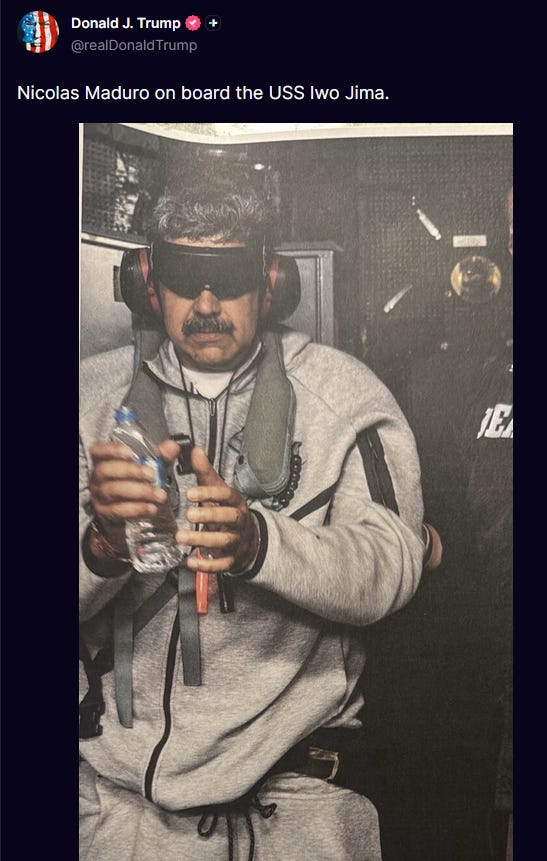
This morning I woke to the incredible news that American forces had successfully extracted Venezuelan dictator Nicolás Maduro and his wife without losing a single man. Having been indicted by the Southern District of New York for various crimes including drug smuggling in 2020, Maduro—like Noriega before him—now faces a criminal trial in the United States. In a news conference this morning, President Donald Trump called it “one of the most stunning, effective, and powerful displays of American military might and competence in American history.”
Many Republicans who initially supported President George W. Bush’s invasions of Iraq and Afghanistan in the early years of the 21st century have since become deeply averse to foreign intervention. On the two-year anniversary of the American withdrawal from Kabul, I wrote an essay looking back at how Republicans—and America—squandered our unipolar moment following the end of the Cold War:
The purpose of the United States military is to defend American citizens and interests. According to the Constitution, though the president is commander-in-chief of the military, it is ultimately Congress that decides when and where to deploy our service men and women. Yet our elected leaders have entirely abdicated that responsibility. Congress passed an authorization for use of military force in 2001 that is still used by the Biden Administration today as a blank check to deploy our troops anywhere in the world for essentially any reason. Numerous attempts to repeal the AUMF have failed.
President Trump campaigned on ending forever wars in 2016, and again in 2024. Nevertheless, his tough talk continues to concern those for whom the memory of the Global War on Terror is still fresh. When Trump ordered airstrikes against Syria in 2017, pundits predicted another Afghanistan. When Trump ordered the assassination of Iranian General Qasem Soleimani five years ago today, many feared it would lead to another protracted war.
Last summer, when American troops bombed Iran’s nuclear facilities, commentators such as Dave Smith and Tucker Carlson screamed that it was the start of World War III and that President Trump had betrayed us all. Once again, none of their dire predictions came to pass. I wrote at the time that Trump had earned at least some benefit of the doubt:
Donald Trump doesn’t fit that mold. He approaches geopolitics the way he once approached real estate deals. Instead of seeing heroes and villains, he sees actors with interests and goals. Countries usually go to war only when no other option remains to achieve their aims. Carl von Clausewitz explained two centuries ago that war is politics by other means.
By applying a transactional rather than moral framework, Trump has achieved what few leaders ever manage: bringing warring sides to the negotiating table. Beneath the religious and apocalyptic overtones of Middle Eastern politics are rational actors who don’t want to see their nations destroyed. The ayatollahs want to stay in power and avoid ending up like Saddam Hussein or Moammar Gaddafi—so how do we give them a way to back down? Israel wants to avoid a belligerent Iran that funds Hezbollah and Hamas or builds a nuclear bomb—so how do we address that?
While I remain concerned about my country becoming enmeshed in yet another forever war that drains our resources and cripples our best young men and women, I’ve not yet seen any evidence that Donald Trump will inevitably repeat the mistakes of George W. Bush. Trump has engineered a strategic realignment toward the Western Hemisphere, following in the footsteps of presidents like James Monroe and Theodore Roosevelt. His appointment of Marco Rubio as secretary of state was part of this strategy, as Rubio—the son of Cuban émigrés—has long advocated a stronger American influence in the Western Hemisphere.
President Monroe’s stance, known to history as the Monroe Doctrine, declared to European powers that the age of colonialism was over and that the United States would be the hegemon of the Western Hemisphere. Theodore Roosevelt added his corollary, asserting that the United States would intervene in Latin American affairs should we decide it was necessary.
President Trump added his own corollary in the recent National Security Strategy document, explicitly referring to the Monroe Doctrine and reiterating the president’s desire to reassert American preeminence in the Western Hemisphere. In his press conference today, Trump claimed that the Monroe Doctrine had been superseded by the “Donroe Doctrine.”
Depending on your perspective, Trump’s strategy is either a dangerous escalation of geopolitical tensions or a return to a time-tested American approach. Consider that the operation to exfiltrate Nicolás Maduro accomplished multiple things:
It removed an implacable enemy who was flooding our country with drugs and illegal aliens while funding our geopolitical foes.
It will deny China yet another foothold in South America.
It serves as a demonstration of American military power to other potentially belligerent nations, such as Mexico and Cuba.
Scheduling the strike while a Chinese delegation was in Caracas to sign security guarantees with Maduro, as well as striking the mausoleum of Maduro’s predecessor Hugo Chávez, were the cherries on top of the operation.
One can still disagree with President Trump’s actions without falling into trite comparisons with Bush-era policies. Remember that George W. Bush’s rationale for a full-scale invasion of Afghanistan was to avoid the mistakes of his own predecessor, Bill Clinton, whom he saw as ineffectual in his responses to terrorism:
When I take action, I’m not going to fire a $2 million missile at a $10 empty tent and hit a camel in the butt. It’s going to be decisive.
Yet Bush erred in the opposite direction, miring us in a never-ending conflict between tribes and sects that have been at war with each other for centuries. Trump’s actions thus far have been both limited and decisive, which seems to be the best possible outcome.
Idahoans reacted to the news this morning in various ways.
Ryan Spoon, an Army veteran and Ada County Republican officer who is skeptical of military intervention, posted a quote in response to the operation:
The distance between madness and genius is measured only by success.
Theo Wold, former Idaho Solicitor General and Trump White House alum, posted in support of the operation:
Actually, America does not have to tolerate an illegitimate communist regime in the Western Hemisphere that facilitates drug trafficking and illegal immigration across our borders and enriches our adversaries with its oil exports because of whatever people decide “international law” means on any given day. It’s our side of the world and it’s well within our interests to keep China out of our backyard.
Congressman Russ Fulcher issued a statement on social media:
Nicolas Maduro is a narco-terrorist authoritarian leader responsible for the deaths of countless Americans. He has faced charges in the United States since 2020 and has clung to power through sham elections not recognized by much of the civilized world.
At his direction, illicit drugs and violent cartel members have poured into our country, devastating communities and families.
I commend President Trump’s bold leadership to protect American lives and our military for their bravery, precision, and professionalism.
At this time, I pray for the Venezuelan people hungry for freedom.
Sen. Mike Crapo posted a statement as I was finishing up this article:
The arrest and indictment of Nicolas Maduro is welcome news. For years, Maduro’s leadership perpetuated violence, corruption and drug trafficking that harmed the Venezuelan people. The influx of illegal drugs from Venezuela further posed serious threats to the American people. I commend the Trump Administration and the brave men and women who carried out this successful operation to bring Maduro to the United States to face justice for his crimes. This marks a critical step toward restoring democracy and stability in the region.
In the end, Ryan Spoon is right—the wisdom of a course of action depends on whether it succeeds. Donald Trump has been remarkably successful thus far, but there’s no guarantee that streak will continue indefinitely. Pray that our leaders be very careful and mindful of the paths down which they lead our nation and our posterity.
Feature image by Donald J. Trump on TRUTH Social.