

A tour through our elections systems
A few weeks ago, President Donald Trump spoke to the nation about intelligence reports regarding Chinese interference in the 2020 election and an apparent refusal by the intelligence community to share that information with him at the time. He urged the Senate to pass the SAVE America Act, which would mandate election integrity provisions including photo ID requirements and the removal of non-citizens from voter rolls. A document released by the Department of Homeland Security included Idaho on a list of states that are proactively implementing SAVE Act provisions, including efforts to remove non-citizens and deceased individuals from voter rolls.
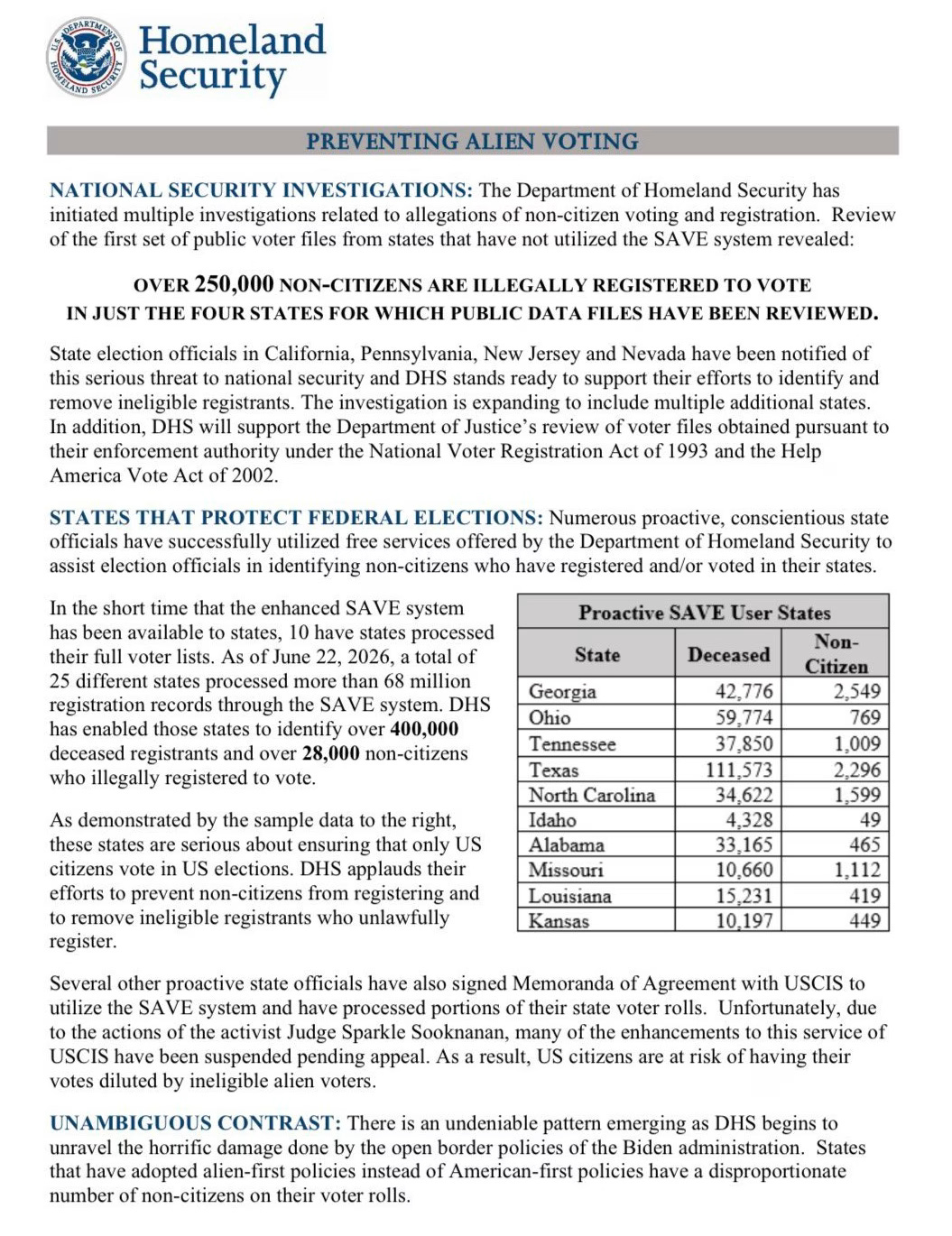
In a recent newsletter, Secretary of State Phil McGrane highlighted the seeming contradiction of being praised for election integrity while at the same time being sued by the Justice Department for withholding certain voter data. The dispute centers on whether Idaho must provide the federal government with full access to its statewide voter registration database, including potentially personally identifying information about registered voters. I asked the secretary about that lawsuit during a recent conversation:
I can see both sides of this issue. On the one hand, I trust the Trump Administration and Assistant Attorney General Harmeet Dhillon to use voter data responsibly and ensure that only citizens are registered to vote. On the other hand, I see the secretary’s point that his office has already gone above and beyond in working with the federal government on that issue, and he has a responsibility to protect the personal information of Idaho citizens. In his newsletter, McGrane reiterated that his office has been carrying out instructions from Gov. Brad Little to ensure that non-citizens are kept off the voter rolls and removed if they should appear there.
The Secretary of State’s office issued a press release last year announcing the arrest of two men in Ada County for voting illegally. One was a non-citizen, while the other was still on felony probation.
When it comes to election integrity, it’s important to filter signal from the noise. One of my earliest Substack newsletters, published in January 2022, called out figures like Mike Lindell who—though perhaps well-meaning—made such wild accusations that it became easy to portray anyone concerned with election integrity as a raving conspiracy theorist. As usual, I believe the truth is often much more mundane than imagination.
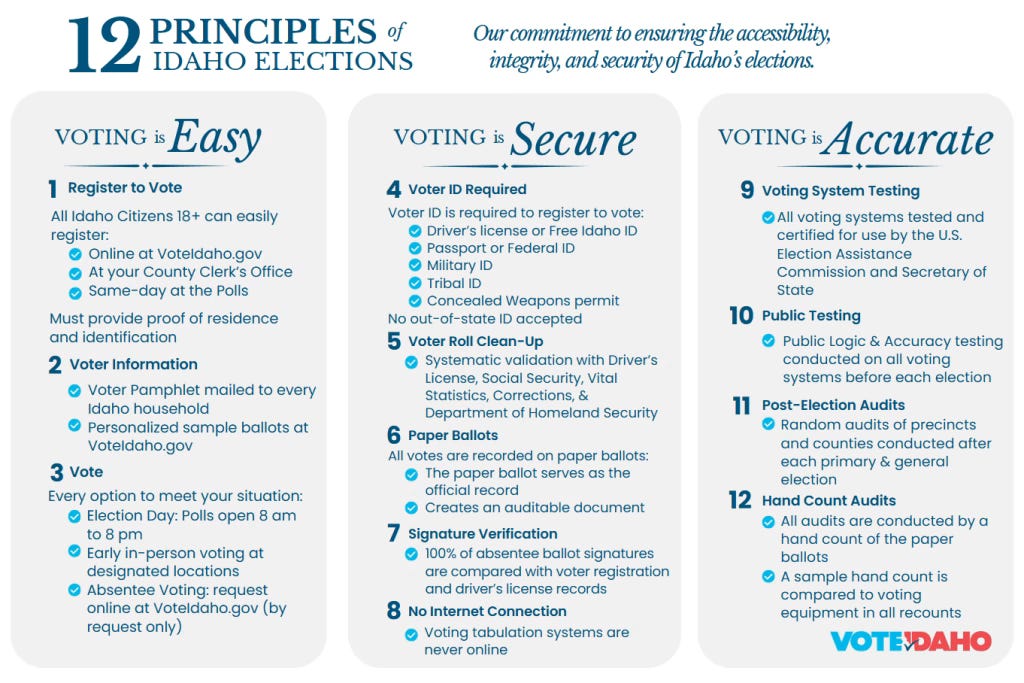
Idaho has already adopted many of what most conservatives would consider best practices for election integrity, including photo ID at the polls, post-election audits, and a requirement that voters proactively request absentee ballots. There is more I would personally like to see, including eliminating no-excuse absentee ballots and moving to Election Day-only voting, but we are definitely ahead of the curve.
One easy lift would be to eliminate the voter affidavit loophole, which Sen. Brian Lenney has been fighting for several years. Under the current system, a person can walk into a polling place without ID, sign an affidavit affirming their identity, and cast a ballot. While the system is intended to accommodate voters who lack acceptable identification, critics argue it creates an opportunity for abuse because poll workers have no practical way to verify whether the person is telling the truth.
Secretary McGrane and his office promote what they call the 12 Principles of Idaho Elections:
The best way to understand Idaho’s election systems is to spend a day as a poll worker. I’ve had the privilege of serving as chief judge in three different elections at three different polling places, and it has given me a much greater perspective on how elections are handled in Ada County. Voters fill out paper ballots, which are tabulated by an optical scanner and then deposited into a secure ballot box for safekeeping. The scanners are not connected to the internet, and the flash drive containing the vote count is kept in a locked compartment to which none of the poll workers have the key.
Ballot boxes are secured with numbered seals. When the first voter arrives, he or she verifies that the boxes are empty, and the chief judge closes them in a container beneath the scanner, sealing them in the first voter’s presence. Once the polls close, poll workers open the containers, remove the ballot boxes, and seal them again for transport to the elections office. The chief judge takes the ballots and scanners back to the elections office, where the ballots are removed and tabulated.
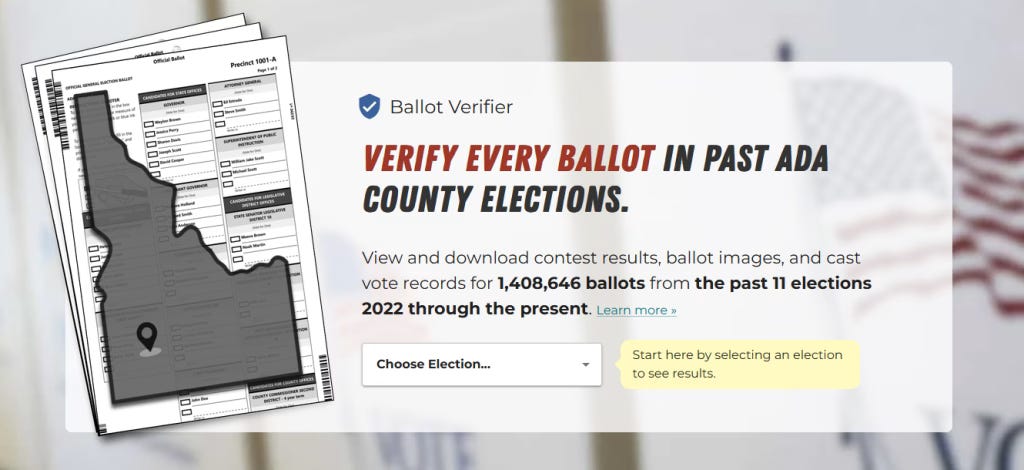
The best antidote to distrust is transparency. The more voters understand how elections actually work, the less room there is for unfounded suspicion, and the more we can focus on what actually needs to be done. To that end, Ada County has a very cool feature called the Ballot Verifier that allows you to view scans of every ballot cast in every election since 2022:
If a voter were to put some unique mark on their ballot, they could browse the verifier, find their ballot, and confirm that their votes were correctly tallied. For example, I found this ballot from a voter in my precinct (it wasn’t me) who only cast a single vote for Mark Fitzpatrick and left the rest of the ballot blank:
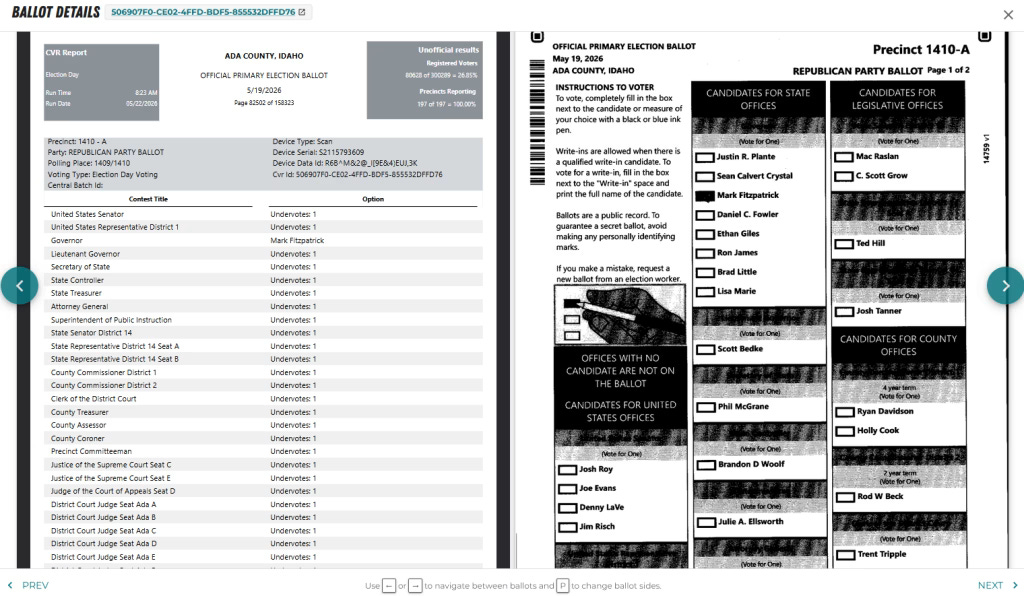
I found another ballot from my precinct (once again, not me) from a voter who made very sloppy marks, but as you can see, the optical scanner interpreted them correctly:
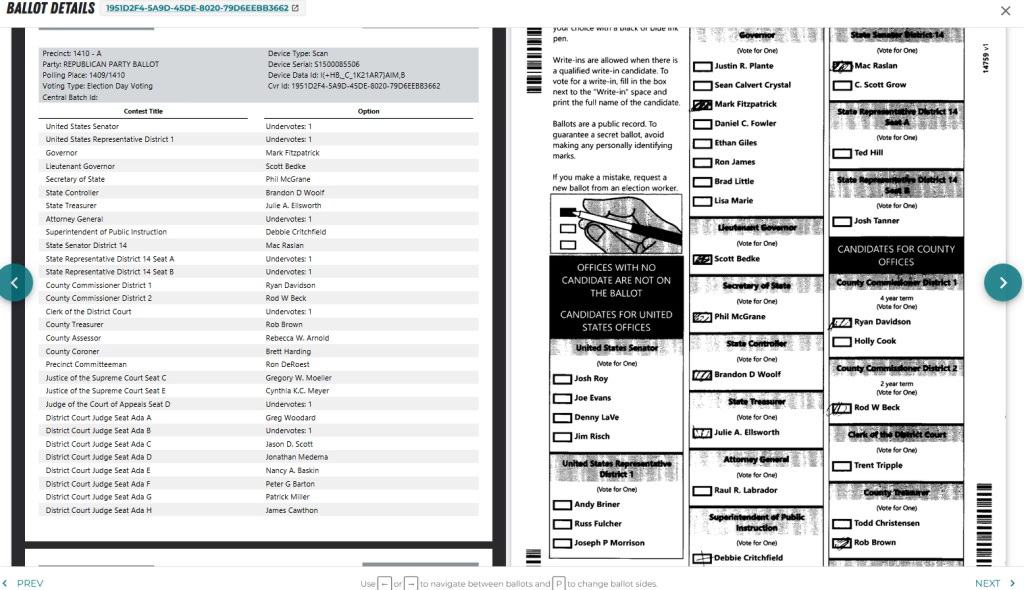
Ballot Verifier even lets you view images of early and absentee ballots in addition to those cast on Election Day.
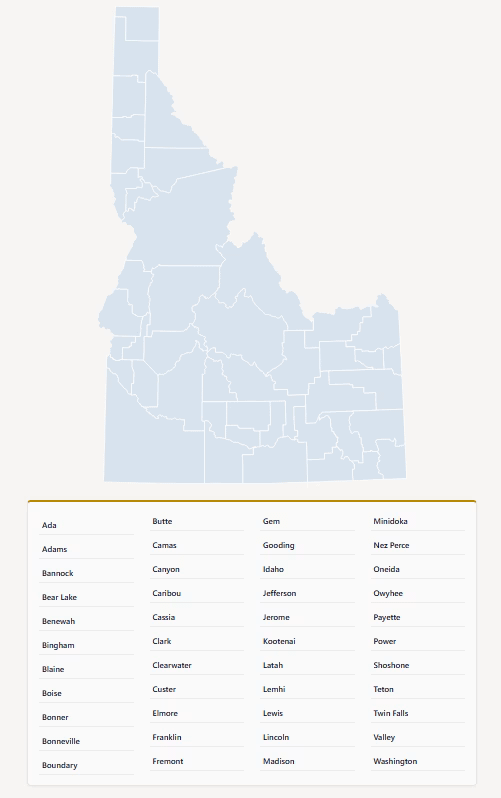
In Idaho, all 44 counties run their own elections, which makes sense because what works in big Ada County might not work in little Clark County. The first place to go if you have questions about elections is your county clerk. Idaho Insider at the Gem State Chronicle makes it easy for you to connect with your county’s elections office—just visit the County Information page and find your county on the map or on the list!
One thing I’ve learned in my time as a poll worker is that the biggest vulnerability in any system is people, not technology. All the election safeguards in the world don’t matter if a poll worker bends the rules and allows someone to vote without being properly registered or showing ID. That is why the best thing you can do to ensure election integrity is to step up and serve as a poll worker yourself.
It not only gives you an opportunity to see the process up close, but it also gives you a chance to ensure that the law is followed to a tee, at least in one polling place. Poll workers aren’t usually longtime government employees, but regular folks—whether retired, self-employed like me, or taking a day off work to serve their communities. Ada County, at least, pays poll workers a small amount, but the experience is the real value in serving.
Feature image courtesy of Ada County Elections.
Data center tax breaks?
Rep. John Gannon is a Boise Democrat who has spent a long time discussing and debating the tax breaks that Idaho offers various businesses who set up shop here. He shared an op-ed that I thought was worth posting for the attention it brings to the way in which technology companies are taking advantage of tax incentives in Idaho:
Data Center property taxes tell a similar story. The Idaho State Tax Commission representatives informed my committee that once a qualifying project exceeds $1 billion in investment, its taxable value is capped at $400 million. A proposed $4 billion data center in Kuna, for example, could pay property taxes on only about 10% of its actual value, the representative said. At a 0.006 levy rate, that amounts to approximately $2.4 million annually, down from the roughly $24 million annually that would provide real property tax relief for all properties.
This generous property tax break means that properties that do pay, such as most commercial and residential, pay more. How? Property taxes are equalized. All the property value is added up, and then a levy rate is applied. So, if there is more property value in a jurisdiction, the levy rate can go down, and your property taxes are reduced – a lot if a big data center pays. If a property is exempt, the remaining properties pay more because the levy rate has to be higher.
Our nuclear future
Sen. Jim Risch shared a short note lauding the ways in which Idaho and America are investing in nuclear technology:
The future of nuclear energy is here, and it’s happening in Idaho.
As the birthplace of nuclear electricity and home of the Idaho National Laboratory, the Gem State has long led the world in nuclear innovation.
Just before America’s 250th Birthday, three microreactors went critical at INL, a historic milestone that further solidifies the United States – and Idaho – as THE leader in nuclear energy.
These successful demonstrations mark an important milestone in the deployment and commercialization of advanced reactors. As important, it makes us one step closer to a new generation of safe, reliable, and affordable American energy.
But that’s not all.
On that same subject, Lt. Gov. Scott Bedke issued a press release today highlighting Idaho as a potential host for the Nuclear Lifecycle Innovation Campus:
Idaho has been synonymous with nuclear innovation since the earliest days of the atomic age, and today’s announcement is a recognition of decades of work by the scientists, engineers, and communities at Idaho National Laboratory and across our state. This is an opportunity to build on that legacy, bringing new investment, new jobs, and new technology to Idaho while helping restore America’s leadership in the full nuclear fuel cycle.
I’m working on several stories right now, including a deep dive into the data center tax breaks Rep. Gannon brought up. Stay tuned! I also turned yesterday’s long article on ALPRs into an audio podcast, so check that out at Spotify, Apple, YouTube, or wherever you get your podcast content.
Make sure to check out Idaho Insider, your one-stop shop for information about your elected officials. I plan to continue adding features throughout the rest of 2026, so bookmark it now, share it with your friends, and check back often to see what’s new!
As always, thank you to sponsors Lynn Bradescu’s Boise Realty, Money Metals, and New Saint Andrews College. Thank you also to all the paid subscribers who make it possible for me to do what I do, as well as all the readers who are constantly encouraging me to keep it up. I appreciate you!
Great tour through Idaho and especially Ada County's election integrity tools. Thank you! Phil McGrane has done exemplary work as far as we can tell, both as Ada County Clerk and Secretary of State.
(* but see additional comment below...)
A few points:
- We agree that Idaho should implement the SAVE system at the state level, but should NOT turn over voting records to the federal government. While some may trust Donald Trump and Harmeet Dhillon with these records, databases can be hacked or leaked, a new Administration could be less trustworthy, and the Deep State is never trustworthy.
* Our issue with the Federal SAVE Act as currently written is allowing/encouraging use of REAL ID. This is a step down the slippery slope of national digital IDs and all that they imply (see https://tinyurl.com/3pjcv7y2)
- We agree with Rep. John Gannon that property tax breaks for data centers should not be allowed. In fact, we believe the same for non-profits (e.g., hospitals and other NGOs) and all other companies. Tax breaks that favor one group over another are unfair; who knows, they may even be unconstitutional! Surely, they are immoral. The abuse of tax breaks is rampant. Trying to stop abuse is nearly impossible as we've seen. The best solution is not to allow these breaks in the first place. Of course, this idea likely won't fly, given pro-business, pro-NGO, pro-private/public partnership views in Idaho and at the federal level.
- The race to implement nuclear power should be a careful one. Yes, we need more power. But honest guardrails must be in place to ensure safety for surrounding communities and environment anytime the nuclear option is proposed or implemented. (See Grok discussion of what happened to Idaho downwinders who were assured by government about safety of atmospheric nuclear tests (1951–1962): https://grok.com/share/c2hhcmQtMi1jb3B5_02ea6cc9-15f7-4f7a-b547-bbd5a5b30de7)
- Loving the improvements to Idaho Insider! Superb work.
* Additional comments:
The following may no longer be an issue, but we did note (and report) possible election irregularities in Ada County during the 2022 primaries (https://ballotpedia.org/Idaho_elections,_2022)
Yes, that's ancient history, but we still think it's worth mentioning weak links in Idaho's system. Two issues occurred: Possible irregularities transporting drop-box ballots to the counting house and ballots being kicked out of the ballot reader on election day.
--- Drop-Box Ballots ---
11/2/2022 10:30am approx. Two Ada County election workers were unloading the ballot drop box at Eagle City Hall (Address: 660 E Civic Ln, Eagle, ID 83616, Phone: 208 939 6813). They had a puny key to unlock the box. They put the loose ballots into a gray zippered soft-sided box. There was no lock of any kind on the box. They reassured us of the following (none of which reassured us):
1. Two people always work together on the unloading.
2. The box is delivered to the election warehouse where it is kept in a locked cage.
3. Ada County allows public access to all the surveillance footage in the warehouse (we did not verify that).
4. Concerns are the following:
a. The election workers may not be honest, so two people working together does not ensure honesty.
b. We have no way to know what happens to that unlocked zippered bag between the time it leaves the ballot pickup area in front of City Hall and the time it arrives at the election warehouse.
--- Kicked Out Ballots ---
In 2022 primaries, we reported problems with voting machines spitting out ballots in Eagle (Ada County), ID. The machines literally had to be kicked by an election worker before our resubmitted ballots were accepted; only the first page with liberty candidates was rejected; the second page went through fine. This happened all day to multiple voters, per the poll watcher.
Secretary McGrane can have his 12 principles of voting, sealed ballot boxes, scanners, tabulators and seals. All are important, but Idaho won’t truly have safe elections until the voter affidavit loophole is eliminated. With it in place, anyone (citizen or not) can walk into a voting location without any identification and vote. I would like this eliminated next year. Is anyone seriously working on it?