

On Thursday evening, I watched the floor debate on Senate Bill 1419, which would have codified and regulated the Idaho Child Care Program (ICCP). Rep. Jordan Redman, who presented the bill in committee earlier this week, argued that it was necessary to ensure legislative oversight of the program, as well as to give the attorney general explicit jurisdiction to investigate fraud. He explained that ICCP had operated for more than three decades without direct statutory oversight, following its creation by the Department of Health & Welfare (DHW) in the early 1990s.
Critics, including the Idaho Freedom Foundation, argued that the bill would enshrine ICCP into law, making it more difficult—not less—to repeal in the future.
Watch the debate here, in which the Senate rejected S1419 on a vote of 11-23-1:
Read these previous articles for additional background on this program:
August 20, 2024: The Cost of Government Childcare
September 6, 2024: What Should We Do About Child Care?
December 29, 2025: Raising Questions About Childcare Subsidies in Idaho
January 1, 2026: What Next for Child Care Subsidies?
March 12, 2026: Update on Idaho Child Care Subsidies
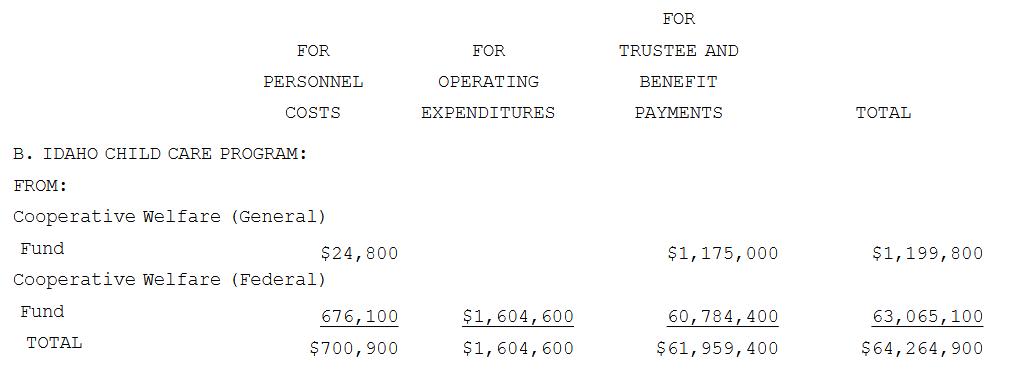
Sen. Scott Grow argued that the state should not be involved in childcare and suggested that codifying ICCP through S1419 would make it harder to eliminate in the future. He pointed to the just-passed Senate Bill 1435, which funded numerous DHW programs, including ICCP. That maintenance budget included just over $64 million for the program, nearly all of which comes from the federal Child Care and Development Block Grant (CCDBG).
Sen. Camille Blaylock agreed that the state should not be involved in childcare but argued that, since the program is already funded, it should be codified to provide oversight now and allow for repeal later.
Sen. Brian Lenney initially agreed with Blaylock’s position, supporting the bill in committee out of a desire to ensure oversight in the short term. However, he ultimately voted against it on the floor, arguing that “[b]olting better guardrails onto something that shouldn’t exist doesn’t make it worth keeping. It just makes it harder to kill later.”
It was Lenney who started the ball rolling on this issue in the first place, cosigning a letter with Rep. Josh Tanner just before the start of the session urging DHW Director Juliet Charron to pause distribution of $14 million for daycare startups approved in 2025 until safeguards could be put in place to prevent Minnesota-style fraud from occurring in Idaho.
Director Charron’s letter earlier this month, suggesting that DHW might be unable to continue operating ICCP without new legislation, prompted S1419. However, Lenney and Sen. Josh Keyser requested an opinion from Attorney General Raúl Labrador’s office regarding the program’s legal status. Chief Deputy Attorney General Phil Skinner responded with a four-page memo suggesting that ICCP does, in fact, have legal standing. Skinner pointed to more than three decades of appropriations and administrative rule approvals as evidence that the Legislature has tacitly approved the program.

There are several important questions raised by this situation:
Should Idaho subsidize childcare costs?
If yes, should the Legislature exercise greater oversight of the program?
If no, what is the best way to repeal it?
Do the short-term benefits of codification and regulation outweigh the long-term risk of further entrenching the program in Idaho law?
Over the past few days, I’ve spoken with several thoughtful people who hold differing views on this issue, and it’s difficult to reach a clear conclusion. A big part of the challenge is that it’s impossible to predict the future with certainty. Will codifying ICCP make it easier or harder to repeal? Will allowing DHW to continue operating the program with minimal legislative oversight increase the risk of fraud? No one knows with perfect certainy.
When DHW implemented ICCP in the early 1990s, it was not in response to a specific law passed by the Legislature. Recall that under the Idaho Administrative Procedure Act (IDAPA), state agencies are authorized to create rules to implement state law. Idaho Code § 56-202 specifically authorizes the director of the Department of Health and Welfare to “promulgate, adopt, and enforce such rules and such methods of administration as may be necessary or proper to carry out the provisions of title 56, Idaho Code.”
That is the authority cited in IDAPA 16.06.12, which governs the Idaho Child Care Program. It is worth taking a few minutes to read through the 23 pages of ICCP rules, keeping in mind that they were drafted within the executive branch. While the Legislature must approve administrative rules, once in place they can be difficult to fully repeal.
The fundamental questions, then, are whether DHW acted within its statutory authority in creating ICCP in the first place, and whether the Legislature’s continued funding and rule approvals constitute affirmation of the program’s legitimacy.
One of the foundational principles of our system of government is the separation of powers, including the doctrine of nondelegation. Each branch is meant to exercise its own powers, not encroach on the authority of the others. Article II, Section 1 of the Idaho Constitution lays this out clearly:
The powers of the government of this state are divided into three distinct departments, the legislative, executive and judicial; and no person or collection of persons charged with the exercise of powers properly belonging to one of these departments shall exercise any powers properly belonging to either of the others, except as in this constitution expressly directed or permitted.
Nearly a century ago, the United States Supreme Court addressed this issue in Schechter Poultry Corp. v. United States, ruling that Congress could not delegate its lawmaking authority to the executive branch. As part of the New Deal, Congress had passed the National Industrial Recovery Act of 1933 (NIRA), granting President Franklin D. Roosevelt broad authority to respond to the Great Depression. Under NIRA, the administration worked with trade associations to develop industry rules that carried the force of law.
Some of those rules were highly specific—even regulating how chickens could be sold. Customers were not allowed to select a specific chicken, but a New York company, Schechter Poultry, ignored that requirement. The federal government prosecuted the Schechters, who appealed their case to the Supreme Court. The Court unanimously ruled in their favor, striking down portions of NIRA as unconstitutional. One key part of the ruling was that Congress had delegated too much legislative authority to the executive, which is tasked with enforcing the law—not creating it.
Does ICCP fall under a similar principle—an administrative creation lacking clear legislative authorization? Or is Chief Deputy Attorney General Skinner correct that DHW acted within its lawful authority? If a court were asked to weigh in, would three decades of appropriations and rule approvals amount to legislative ratification?
For those who believe the government should not subsidize childcare, the debate ultimately comes down to the perspectives offered this week by Sens. Grow and Blaylock. Is it necessary to codify ICCP in order to better control it—and potentially repeal it later? Or should the Legislature allow the program to continue for another year and return in 2027 with a plan to phase it out?
Unless the Legislature acts quickly next week, the question is moot for now. Many Republicans opposed S1419 out of concern that it would permanently entrench a government program, while many Democrats opposed it due to the additional regulations it would impose. Now it will fall to JFAC to determine how to handle the $14 million in funding that was pulled back at the last minute—and to a future Legislature to decide what role, if any, the state should play in subsidizing childcare.
Feature image is a pastiche of screen captures from the Idaho Public Television broadcast of the Senate floor debate, with some assistance from Grok.