

Click here to listen to this episode as a podcast.
Politics can be an emotional arena. With so much at stake—money, freedom, our future—it’s no wonder people become passionate about their causes. Yet if you want to be successful in politics—if you want to achieve the policy victories you set out to win—you have to temper that passion with reason and discipline.
The Legislature is a brutal arena. I’ve watched lawmakers spend half an hour trying to convince a committee to print a bill, only to see it go down in defeat. There’s no time to sulk. They’re next on the agenda with another bill, and the work continues.
I recall sports commentators saying that star players have short memories. If Michael Jordan missed a shot, Jerry Rice dropped a pass, or Ken Griffey Jr. struck out, each had to shake it off and get back to work. Miss the last nine shots? Believe you’ll make the tenth. The past is over. Focus on the next play.
In chess, there’s a concept known as “tilting,” and I know it well. Lose a few games in a row—especially because of your own mistakes—and you can spiral. You lose focus, then lose more games. The best cure is to step away for a while rather than doubling down out of frustration. NBA stars and legislators don’t always have that luxury, which is why emotional control matters so much.
I’ve seen lawmakers watch a colleague torpedo their bill, only to have to work with that same colleague an hour later. By all means, remember who wronged you and factor that into future decisions. But nursing a grudge makes it harder to get anything done. When a respected conservative eviscerated a resolution I was carrying to the Summer Meeting last year, I could have declared that person an enemy for life. That would have been absurd. Why cling to resentment against someone who is otherwise a powerful ally?
When emotion takes over, everything becomes personal. Years ago, I realized that politics often resembles Mean Girls more than Mr. Smith Goes to Washington. People slight one another, stab each other in the back, trade insults, and then carry those wounds for years, letting them shape every future interaction. I didn’t grasp how much energy would be wasted on endless personal vendettas when I first stepped into Idaho politics six years ago. The reason a handful of former allies constantly hammer me on social media essentially comes down to this: I refuse to hate who they hate.
And it goes well beyond the Capitol. People who cannot master their emotions are easily manipulated. I’ve written before about how so much political discourse—especially online—is nothing more than outrage bait, designed to make you angry so that you’ll click a link or sign a petition or donate money to some cause.
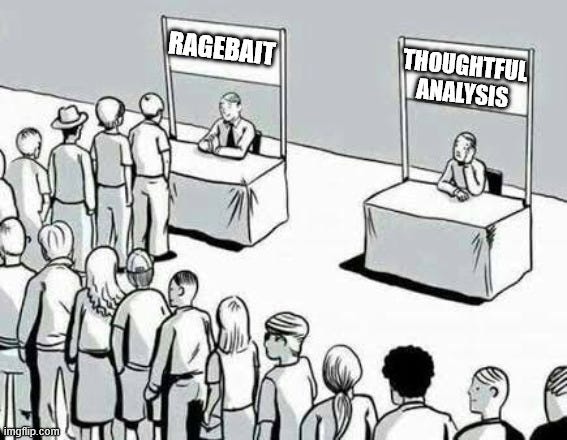
How much of our online conversation consists of raging about things over which we have no control? Did you see what President Trump posted? What about Iran?? Why isn’t anyone talking about the Epstein files???
Conservatives used to repeat Ben Shapiro’s maxim that “facts don’t care about your feelings.” Yet much of today’s discourse is driven almost entirely by feelings. Years ago, YouTuber CGP Grey explained how social media algorithms are built to amplify anger. If that was true then, it’s even more powerful now:
Most of us have limited ability to shape events at the national or global level, yet we devote enormous energy to being angry about them. Remember the Serenity Prayer:
God grant me the serenity to accept the things I cannot change
Courage to change the things I can
And the wisdom to know the difference.
When we pour anger into matters beyond our control, we waste time and energy. Our emotions should guide us toward action, not inaction.
Look at who is actually effective in Idaho politics—who is advancing a clear agenda. Is it the people constantly sparring on social media, chasing every outrage like a dog after squirrels, and spiraling down ragebait rabbit trails? Or is it those who remain calm and steady, letting events roll off them like water off a duck’s back?
Perhaps Rudyard Kipling said it best:
If you can keep your head when all about you
 Are losing theirs and blaming it on you,
If you can trust yourself when all men doubt you,
 But make allowance for their doubting too;
If you can wait and not be tired by waiting,
 Or being lied about, don’t deal in lies,
Or being hated, don’t give way to hating,
 And yet don’t look too good, nor talk too wise:
If you can dream—and not make dreams your master;
 If you can think—and not make thoughts your aim;
If you can meet with Triumph and Disaster
 And treat those two impostors just the same;
If you can bear to hear the truth you’ve spoken
 Twisted by knaves to make a trap for fools,
Or watch the things you gave your life to, broken,
 And stoop and build ’em up with worn-out tools:
If you can make one heap of all your winnings
 And risk it on one turn of pitch-and-toss,
And lose, and start again at your beginnings
 And never breathe a word about your loss;
If you can force your heart and nerve and sinew
 To serve your turn long after they are gone,
And so hold on when there is nothing in you
 Except the Will which says to them: ‘Hold on!’
If you can talk with crowds and keep your virtue,
 Or walk with Kings—nor lose the common touch,
If neither foes nor loving friends can hurt you,
 If all men count with you, but none too much;
If you can fill the unforgiving minute
 With sixty seconds’ worth of distance run,
Yours is the Earth and everything that’s in it,
 And—which is more—you’ll be a Man, my son!
Ask yourself: Is politics a tool to accomplish defined goals? Or is it simply an outlet for anger? If you can take emotion out of the equation, using your passion to hone decisive action in service to your goals rather than driving you every which way the wind blows, then you will be successful in your endeavors.
For my part, the only thing that ultimately matters is preserving life and liberty for my posterity. Everything else is a sideshow.
How about you?
Feature image created with Microsoft Copilot.
Words of wisdom, Brian.
"When emotion takes over, everything is personal."
So true.
Stay rational is easy advice, but so hard to practice.
Thank you.