

The idea of providing lodging for travelers and tourists goes back to the dawn of civilization. The Gospel of Luke tells the story of Joseph and Mary arriving in Bethlehem only to find no room at the inn. In medieval times, caravanserais provided a safe place to lodge for the night along the Silk Road. The framing story of Geoffrey Chaucer’s The Canterbury Tales takes place at an inn in England on the road to the shrine of St. Thomas Becket.
Hotels became popular in the 19th century, with the 1829 Tremont House in Boston serving as an early example. A less expensive option, the motel, saw widespread use in the mid- to late 20th century as car travel became more common. On the other end of the spectrum, the bed and breakfast offered a cozier, more customized experience, with homeowners often renting out rooms or even entire houses to travelers.
Airbnb was launched in 2008, creating a platform for homeowners to offer rooms to travelers seeking an alternative to traditional hotels. Airbnb and other short-term rental (STR) options provide lodging that can be more private or accommodate larger groups than hotels and motels. When I took my family to Arizona last summer to visit relatives, we stayed in Airbnbs rather than trying to reserve multiple hotel rooms for all our children. We had lovely experiences at each location.
As Airbnb and other STRs exploded in popularity, some cities began cracking down. The hotel industry lobbied against STRs, viewing them as competition to their long-established business model. Others raised concerns about the potential impact of travelers on residential neighborhoods. According to Wikipedia, Chicago requires all STRs to be licensed, and single-night stays are prohibited. STR hosts in Los Angeles must register with the city, pay a fee, and are restricted to operating no more than 120 days per year. Miami bans STRs entirely.
Responding to complaints from STR owners that cities were imposing unreasonable burdens on their industry, the Idaho Legislature passed the Short-Term Rental and Vacation Rental Act in 2017. Now codified in Title 63, Chapter 18 of Idaho Code, the law is designed to limit local governments from targeting STRs with excessive regulations.
However, some STR owners believe cities are getting around this law and using ordinances to squeeze them out of business. Melissa Radford, who owns an STR in Coeur d’Alene and founded the CDA Vacation Rental Alliance, spoke with Matt Edwards of Citizens Alliance of Idaho two years ago when she was in Boise promoting a bill to limit city regulations:
That bill died in the House amending order. Another bill failed on the Senate floor the following year, with some arguing that it compromised too much with critics of STRs.
Radford returned to Boise this year with her husband, Jeremy, to continue working toward a solution. The result was House Bill 583, sponsored by Rep. Jordan Redman.
H583 passed the House 54–16 earlier this month and was scheduled for a hearing Thursday afternoon alongside another STR bill, Senate Bill 1263. I ran the text of both bills through Grok and asked it to compare and contrast them.
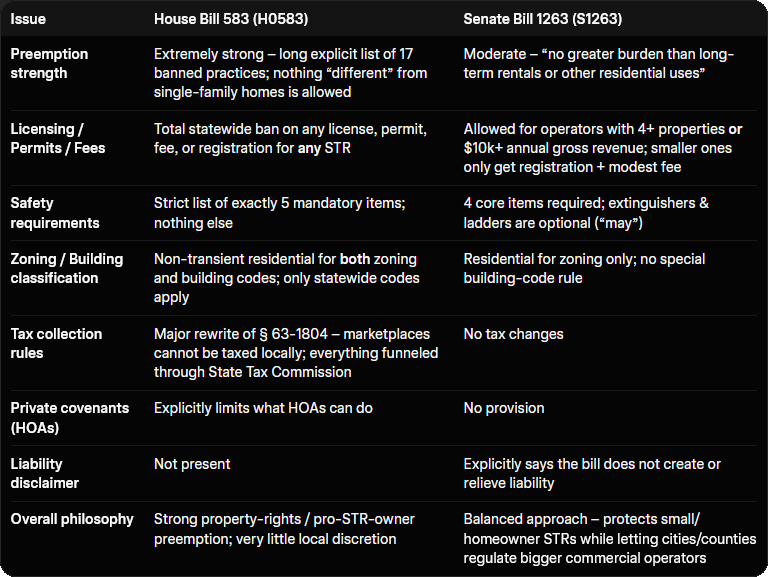
My prompt was neutral—I didn’t share my thoughts on either bill. Nevertheless, Grok clearly concluded that H583 was the stronger of the two.
The Idaho Freedom Foundation agreed, giving S1263 a -1 rating:
The bill would add language explicitly allowing a county or city to require a license, permit, or certification to operate a short-term rental if “a property owner owns or has a financial interest in four (4) or more short-term rentals within the jurisdiction, including units held by commonly controlled entities, trusts, partnerships, or affiliates” or “a short-term rental generates ten thousand dollars ($10,000) or more in gross annual short-term rental revenue, defined as the total amount paid by occupants for lodging before any deductions for expenses, commissions, fees, taxes, or costs of operation during a calendar year.”
H583, on the other hand, received a +1 rating:
The bill would remove broad and ambiguous language that local governments have used to bypass the spirit of the law and generally require (with some exceptions) that local governments only impose “reasonable regulations” that are “necessary to safeguard the public health and safety.” Such regulations must “not impose different restrictions or obligations on short-term rentals than are imposed on single-family dwellings or similar structures not used as short-term rentals.”
Thursday afternoon’s hearing offered a rare opportunity for a legislative committee to effectively debate two bills at once. Sen. Dan Foreman, chairman of the Senate Commerce & Human Resources Committee, took public testimony on both bills before allowing members to act on either. A motion to hold S1263 in committee passed 5–4, and a motion to send H583 to the floor with a “do pass” recommendation carried 8–1.
As is often the case, the debate over STRs comes down to the rights of individuals to use their property as they see fit versus the rights of neighbors to enjoy their own property in peace and safety. As a society, we have already decided there should be certain limits on what people can do with their property—hence zoning laws and ordinances regarding animals, among other restrictions. Many cities prohibit homeowners from operating certain types of businesses from their homes out of concern that constant traffic or persistent noise could create problems for neighbors.
Yet short-term rentals are a different kind of business, aren’t they? Travelers who use Airbnb and other STR platforms typically seek the same quiet and peaceful experience as long-term residents. For those who don’t—such as individuals who want to rent a home for a loud party—existing ordinances against excessive parking, noise, and other disruptions still apply.
Having read the bills and listened to the debate, I believe H583 is an important step in protecting property rights. I do not believe it will lead to the problems some opponents have predicted. I agree with the bill sponsor, Sen. Todd Lakey, who noted that some city ordinances are necessary to protect community safety. But here in Idaho, we seek to ensure that government operates with the lightest possible touch. H583 maintains that light touch, and I look forward to seeing it reach the Senate floor next week.
Feature image created with Microsoft Copilot.