

J.D. Vance and the Kingfish
Vice President J.D. Vance raised some eyebrows at a rally yesterday when he alluded to Huey Long, a Louisiana politician from the 1930s who advocated outright socialist positions while using his power to maintain near-absolute control of his state. Vance said:
“The great southern populist—probably most of you in the room don’t know who I’m talking about, but he’s an interesting guy—kind of a crazy guy—his name was Huey Long, and he once said: ‘every man a king’ was the goal of his political program. But no man is a king if their castle is under siege by criminals. No man is a king if they can’t take their family out to dinner without being mugged or having their car jacked.”
Huey Long was a fascinating and larger-than-life character in American history. He was born into poverty, worked his way through school, and eventually passed the bar to practice law in Louisiana. He quickly found a populist niche, attacking big business and cronyism and developing a reputation for fighting for the common man. He was elected governor in 1928 and immediately began consolidating power. Depending on whom you asked, he was either a champion of the little guy or a complete dictator.
One of Governor Long’s first actions was calling a special session of the Legislature to enact a five-cent-per-barrel tax on refined oil in order to fund his social agenda. He accused anyone who opposed the tax of having been bought by the oil companies. Outrage over the proposal and his rhetoric drove legislators toward impeachment, and an attempt to adjourn the special session before a vote led to a brawl on the House floor. With his political future in the hands of the Senate, Long garnered enough support to avoid conviction, and the session disbanded without an ultimate vote.
Surviving impeachment only made Long more powerful than his enemies could possibly have imagined. He ran for U.S. Senate in 1930, winning with 57.3% of the vote. However, he refused to leave the governor’s office and occupied both seats for more than a year. He feared that if he resigned the governorship, his lieutenant governor, Paul Cyr, would undo his populist reforms. In fact, Cyr attempted to declare himself the acting governor when Long visited Mississippi in October 1931, but Long ordered National Guard troops to surround the Capitol to put down what he called a coup attempt. A court later agreed with Long that Cyr had illegally tried to seize power and expelled him from his seat.
According to historian T. Harry Williams, “the secret of Long’s power, in the final analysis, was not in his machine or his political dealings but in his record—he delivered something.” Under Huey Long’s administration, Louisiana constructed roads, bridges, hospitals, schools, and a new capitol building that remains the tallest in the fifty states. He invested a lot of taxpayer dollars in Louisiana State University, turning it into one of the top schools in the South.
He also ordered LSU to expel students who criticized him in the student newspaper, which is the flip side of the coin when it comes to populist dictators like Huey Long.
Long supported Franklin D. Roosevelt in the 1932 presidential election, but by 1935 he believed his New Deal programs didn’t go far enough. Long wanted to use socialist ideas to fix the Great Depression, including a 100% tax on earnings over $1 million and a cap on accumulated wealth over $100 million. He called it the “Share Our Wealth” plan and promised a basic universal household grant of $5,000 to start, followed by an annual income of one-third the national average. He promised free college and vocational training, subsidies for farmers, old-age pensions, mandatory vacation, a 30-hour workweek, and more. He promised that every man would be a king.
Roosevelt began to fear that Long would challenge him from the left in the 1936 election and began voicing support for programs such as Social Security to try to blunt Long’s populist appeal. History, however, would take the problem off the table. Carl Weiss, the son-in-law of a Louisiana judge whose district was being gerrymandered out of existence, walked up to Huey Long at the Capitol in Baton Rouge and shot him once in the chest. A day and a half later, the Kingfish was dead.
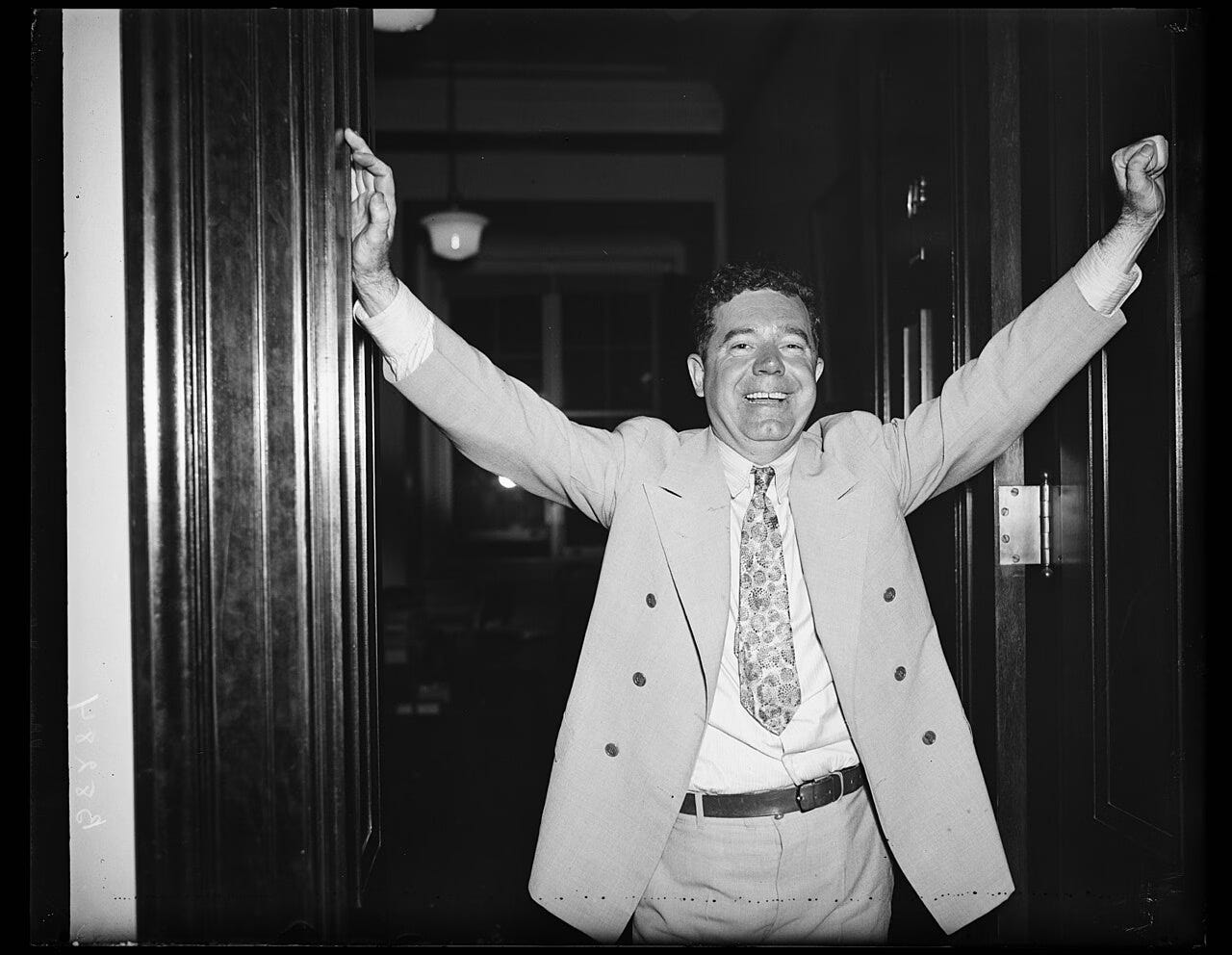
I find Huey Long to be a fascinating historical figure, though of course I disagree with nearly all of his policy positions. His career shows how socialists can seize populist issues to gain political power. Unlike some left-wing populists, Long accomplished things for his constituents, but at a terrible cost. Americans have always known that poverty and hard times are breeding grounds for communism and socialism, which is why we poured billions of dollars into Europe via the Marshall Plan after World War II to ensure communism did not gain a foothold in Greece, Italy, or West Germany. It was the equivalent of U.S. Army Surgeon General William Gorgas clearing the swamps of Panama to eliminate mosquitoes carrying yellow fever and malaria.
Some on the right have thrown the baby out with the bathwater, believing that recognizing the problems with poverty and hard times is akin to advocating for socialism itself. Some free-market conservatives have been attacking Vice President Vance for expressing sympathy with young people today who find the American Dream increasingly out of reach. “Just let the market work,” they say, forgetting that we haven’t had a truly free market in America for generations. We can recognize the problem without adopting the left-wing solutions advocated by men like Huey Long or Bernie Sanders.
This is exactly what Vance was doing in that speech yesterday. He recognized the struggles facing young Americans today and recognized that the obstacles in their path are not the same obstacles faced by previous generations. Our government has imposed innumerable barrier over the past century, from mass migration to DEI policies to the welfare state, each of which makes the American Dream that much harder for hardworking young people to achieve.
Removing these barriers is not “government overreach.” Securing our borders, cracking down on companies hiring foreign workers instead of Americans, eliminating DEI requirements, and reducing the confiscatory taxation necessary to support an expanding welfare state are not the same things as imposing wealth taxes, capping incomes, and overregulating free enterprise. Yet to the free-market critics of men like J.D. Vance, they’re the same picture.
Yesterday’s announcement by President Donald Trump regarding beef imports perfectly demonstrates the paradigm at play here. American beef prices are sky-high right now, and ranchers say it will take years to rebuild American cattle herds after the mismanagement and overregulation of the Biden administration. Americans are suffering (I’ve been buying more ground turkey for my family than ground beef lately), so Trump took action to eliminate tariffs on ground beef for the next three months. Ranchers are outraged, and even Congressman Thomas Massie denounced the plan, despite having opposed tariffs in the past. I suppose in his case, libertarian principles long ago gave way to simply being reflexively anti-Trump.
You surely see the conundrum here: American ranchers want high prices—after all, they have mortgages to pay and families to feed. Yet regular Americans have families to feed as well, which is harder to do when the cost of food is going up along with everything else. This is just the sort of populist moment that left-wing demagogues can seize upon to advance their own power. A Bernie Sanders, Zohran Mamdani, or Alexandria Ocasio-Cortez would suggest that the problem is greedy ranchers and beef processors, and the answer is high taxes, more regulation, or perhaps even just nationalizing the industry altogether.
President Trump didn’t do that. He relaxed import duties for a set period, with the express goal of allowing American ranchers more time to increase supply. It makes sense to me.
When generations face a moment of crisis, they care less about ideological purity than they do about solving the problems at hand. We understood this in 1948, when we sent billions of dollars to rebuild Europe lest those war-weary and impoverished populations turn to the communist banner. We seem to have forgotten it today, as we tell millions of young Americans that they are to blame for their situation and that they must simply pull themselves up by their bootstraps despite the way in which the game has been rigged against them.
Simply repeating “socialism sucks” is not going to stop the specter that is haunting America. We must remove the barriers that government has placed in front of young people and allow the free market to work rather than giving it lip service while ignoring the reality of the situation. J.D. Vance understands this at a much deeper level than most politicians, having grown up in the wreckage of outsourcing, decline, and economic despair. In the same speech in which he invoked Huey Long, Vance pointed out that Democrats like former Ohio senator Sherrod Brown pretend to be the friend of the working man while supporting policies—such as mass migration—that undermine American workers at every turn.
There is no third way in front of us. We either follow Vance’s lead, or we open the door for a modern Huey Long who will promise young people everything they’ve ever dreamed of, the cost of which they won’t know until it’s too late.
Labrador Letter
The grizzly bear is one of the most emblematic animals of the Mountain West, and it is a perfect example of the federal government continuously overreaching into state affairs and management. The Endangered Species Act (ESA) has been a frequent vehicle bringing federal bureaucracy into states, particularly in the West. Spotted owls, wolves, salmon – each one with stifling regulation and economy-collapsing rules.
Grizzly bears were listed as a protected species in 1975. Fifty years later, the grizzly population has grown, and the bears have naturally pushed into areas where Idahoans live, work, and recreate. That expansion comes with public safety risks, damage to private property and livestock, and a heavy management burden on our state agencies and local communities.
McGrane reflects
Our lives can become consumed by whatever is immediately in front of us. The next election. The next controversy. The next deadline. But spend time with these texts and you quickly realize that many of the questions we think are uniquely ours aren’t unique at all.
We are a small part of a much longer human story.
At the same time, we have inherited something extraordinary. Our constitutional system of self-government has been built, tested, debated, defended, and improved upon by generations before us. We don’t own it. For a time, we are simply its stewards.
Video of the day
Rufo & Lomez discuss the craziness of the modern world, from universities rallying around DEI plagiarizers to Flock cameras on every street corner:
Remember to check out all the tools at Idaho Insider, including the brand new Budget Calculator. I just made some adjustments to the calculator, including adding sliders for dedicated funds and updating the final FY2026 numbers now that DFM has published them.
Once again, a big thank you to sponsors Lynn Bradescu’s Boise Realty, Money Metals, and New Saint Andrews College. Thank you also to all the paid subscribers who make it possible for me to do what I do, as well as all the readers who are constantly encouraging me to keep it up. I appreciate you!