There was a time when there was little daylight between business interests and concerns for individual liberty within the Republican Party. President Dwight Eisenhower’s pick for Secretary of Defense, former General Motors president Charles Wilson, famously said, “What’s good for our country was good for General Motors, and vice versa.” President Ronald Reagan lauded the virtues of free market capitalism in contrast to the encroaching tyranny of government regulation. Many current Idaho leaders have built their political philosophy on that foundation, even as the zeitgeist has shifted in recent years. Over the past two decades, conservative Republicans have watched big businesses outsource jobs overseas, adopt woke ideologies including BLM and LGBTQ+ activism, and attempt to force vaccine mandates on employees during the COVID-19 pandemic.
This has created a divide within Republican circles between those who still believe that what’s good for big business is good for the country and those who view corporate America with increasing skepticism. Someone like Gov. Brad Little—successful businessman, longtime political figure, and former chairman of the Idaho Association of Commerce & Industry (IACI)—sees big business as an ally in carrying out his agenda and views the state’s economic situation as his top priority. Just look at the governor’s press releases and op-ed from the past week alone:
To be fair, the economy is very important. We all need to feed our families and put roofs over our heads, which means good jobs, low inflation, and affordable housing. I think we sometimes take for granted how well we have it here in Idaho, and the governor and his policies deserve much of the credit.
Nevertheless, a strain of conservatism has emerged over the past two decades that believes economic prosperity is only part of the story. The populism that has underlain the Trump era sees government and corporations as twin villains rather than casting one as the hero of the story. This dichotomy can be illustrated by two different lobbying organizations in the state: IACI and the Idaho Freedom Foundation (IFF). There’s a certain state senator who, whenever he wants to emphasize the breadth of buy-in he’s sought for a piece of legislation, says he talked to both the IACI folks and the IFF folks.
I wrote about IACI in detail last December, so check out that article for some background. IFF probably needs no introduction for regular readers. It was founded in 2009 by Wayne Hoffman and Heather Lauer, building on the work of liberty stalwarts Ralph Smeed and Maurice Clements. Its original mission was to present policymakers with free market solutions while holding elected officials accountable for expanding government regulations and spending. Former state representative Ron Nate succeeded Hoffman as president of IFF in 2024, while Alex LaBeau has served as president of IACI since 2006.
While the two organizations were often on opposite sides of issues before COVID, it seemed to be during the pandemic that they to drew much harder lines in the sand. IACI supported Gov. Little’s stay-at-home order, along with mask and vaccine mandates, while IFF took both government and corporations to task for infringing on individual rights. IFF’s sister organization, Idaho Freedom PAC, endorsed Ammon Bundy for governor.
Both organizations publish legislative scorecards, though their scope and methodology are quite different. Back in 2023, IFF president Ron Nate wrote an article breaking down the differences between the two scorecards. He noted that there was only one bill scored by both organizations during the 2023 session:
Of the hundreds of bills rated in the Idaho Freedom Index, and the nine bills on the IACI scorecard, there was only one bill scored in agreement: H292, the property tax reduction bill by Rep. Monks and supported by Speaker Moyle. The bill was a modest decrease in property taxes by using general funds to offset property tax needs by local governments.
…
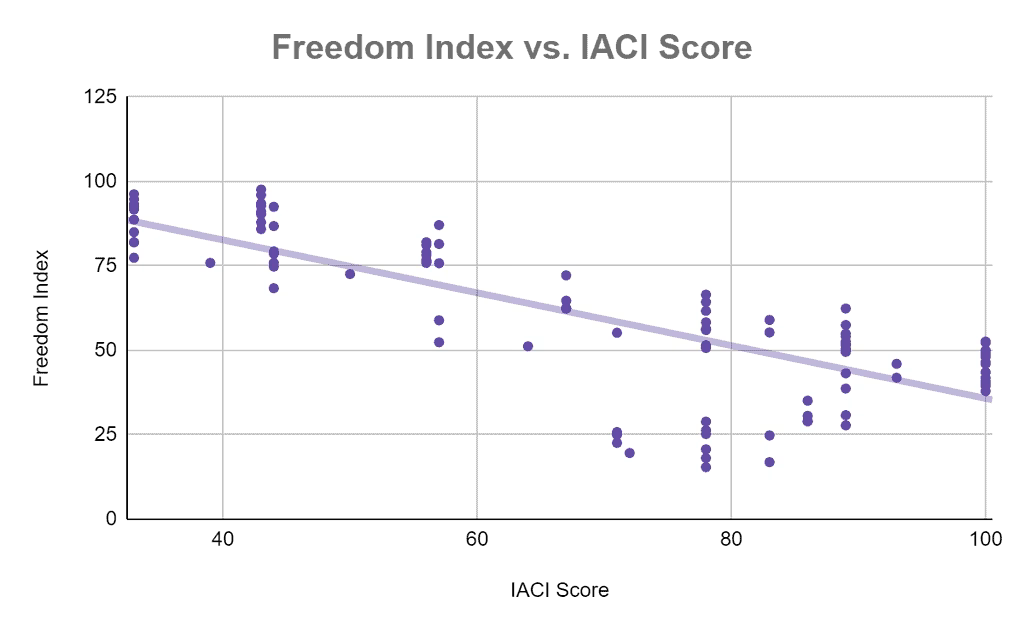
No legislator scoring above 90 percent on the Idaho FREEDOM Index scored above 50 percent on the IACI Scorecard. While the Freedom Index works for the forgotten man, the IACI scorecard works against the little guy. There is nothing conservative about pulling the levers of government in favor of the vested special interests of big corporations.
The graph below says it all; there is a distinct inverse relationship between legislators’ scores on the Idaho Freedom Index versus the IACI Scorecard. IACI works against freedom, period. It is a worthless, self-serving measure of just some of the garbage a big special interest lobby can produce. Idahoans deserve better.
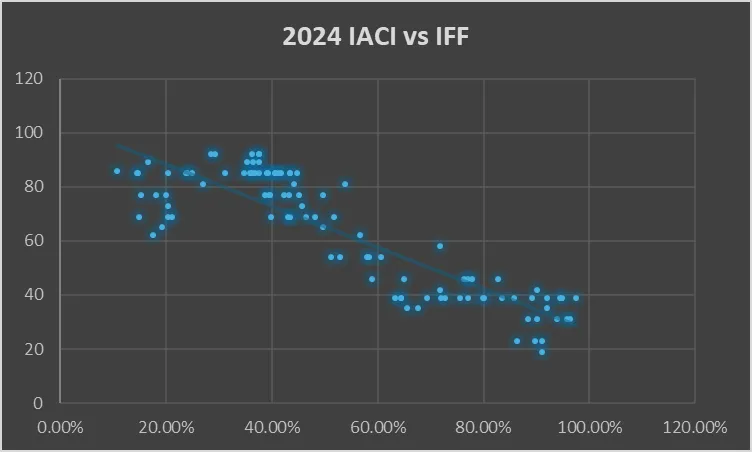
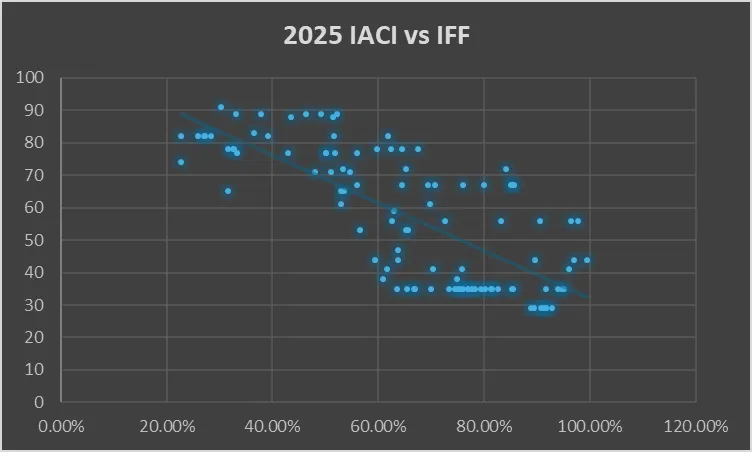
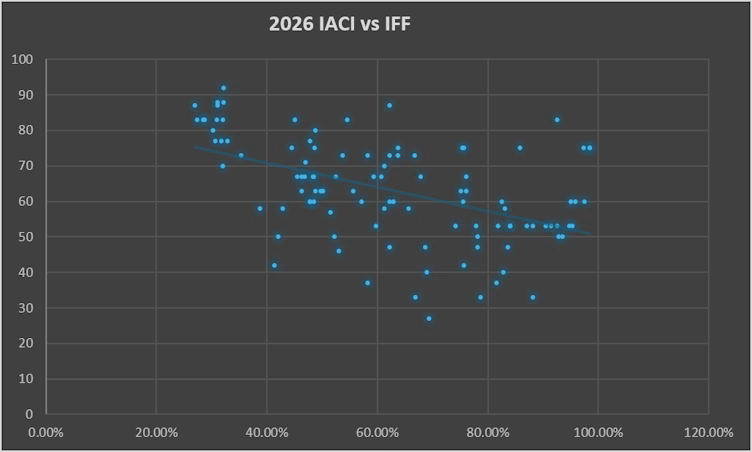
I’ve written several times not only about the scorecards but also about the dueling endorsements of the organizations’ sister PACs—IACI’s Idaho Prosperity Fund and IFF’s Idaho Freedom PAC. This week, I took a closer look at the correlation between the two scorecards that Nate mentioned three years ago. In 2024, the two scorecards remained strongly negatively correlated, to the tune of -0.87. A high score on one almost certainly meant a low score on the other. By 2025, that correlation had weakened to -0.74, and it declined further in 2026 to -0.50.
I’m still not entirely sure what is causing this decrease in negative correlation. To learn more, I fed the last three years of IACI scores, IFF scores, legislator ratings on both metrics, and the final status of every bill from 2024 through 2026 into Claude to see what other patterns it could identify. The biggest finding that caught my eye was how many bills in 2026 never made it to the Senate floor. It wasn’t just immigration bills that were blocked, either by being voted down in Senate committees or unilaterally held by committee chairs. According to this analysis, 135 bills met their end in Senate State Affairs alone—40 more than the second-place committee.
When I last wrote about IACI versus IFF, I questioned why the organization had endorsed challengers to Sens. Glenneda Zuiderveld and Josh Kohl despite each earning a score of 75 by IACI’s own metrics:
The average IACI score of incumbents facing IPF-endorsed challengers is 55.7, only slightly lower than the average for IPF-endorsed incumbents. These scores range from Sen. Dan Foreman, who is being challenged by Rep. McCann and scored just 33, to Sens. Josh Kohl and Glenneda Zuiderveld, who each scored 75. IPF nevertheless endorsed their respective challengers, Brent Reinke and Casey Swensen.
I think that question has now been answered. The issues IACI cared most about never made it to the Senate floor in the first place, so they never appeared on the scorecard. However, the organization and its PAC took them into account when making endorsements.
Another interesting data point is how successful each organization was at passing or killing legislation. In 2026, 47.5% of introduced bills were ultimately passed and signed by the governor. Both organizations posted lower success rates than that baseline on bills they supported—39.2% for IFF and 38.5% for IACI. However, their success rates were much higher when opposing legislation. Of the bills IFF opposed, 74.7% were ultimately defeated, while IACI’s figure was 87%. It is clearly easier for lobbyists and policy organizations to kill bills they dislike than it is to pass bills they support. That makes sense: for a bill to become law, it must be printed, pass two legislative committees, pass both chambers, and be signed by the governor. Killing a bill requires stopping it at only one of those stages.
In 2023, Ron Nate noted that IACI and IFF went head-to-head on only one bill. My analysis shows that in 2026 they disagreed on 14 bills, with IACI winning 11 of those clashes. IACI also had the upper hand in 2025 by a margin of 9-6 and in 2024 by a margin of 12-5. IACI, of course, has a much deeper pool of resources than IFF. Big businesses are willing to pay bigly to support an organization that lobbies on their behalf, while IFF relies primarily on donations from individuals and a handful of companies that favor free markets over subsidies and government intervention.
When I fed this data into Claude, it built me—without my even asking—a comprehensive dashboard based on the data. I’m sharing that with you now. Check it out and see what you find. I plan to continue adding more data and teasing out additional conclusions about the legislative process and how conservatives can become more effective at implementing policy.
Feature image of IFF president Ron Nate and IACI president Alex LaBeau made with assistance from Grok.
Idaho GOP chairwoman Dorothy Moon’s column this week answered the question of why Republicans fight so strongly against abortion:
I’m reminded of a dark time in our nation’s history, when men and women were bought and sold because those doing the buying and selling did not consider them fully human simply because of the color of their skin. The Republican Party was founded nearly two centuries ago to fight the evil and inhuman scourge of slavery, so it’s entirely appropriate that today we fight the evil and inhuman scourge of abortion.
The truth is that the unborn are just as human as you and me. We often call them “preborn” babies because birth is the natural consequence of pregnancy, not a disease that needs to be cured.
Sebastian Griffin is an impressive young council member in Nampa who shared his thoughts on the city’s latest budget on Facebook earlier this month. I’ve reposted those thoughts with permission:
As I sit here doing some light reading of our nearly 600-page budget book tonight, the question keeps coming to my mind:
“Is growth actually paying for itself in Nampa?”
The honest answer is, no, not completely. I’ll be sure to cite to the pages I am looking at, just in case you don’t believe me.
That does not mean every new home is bad, and it does not mean Nampa should completely stop growing. But I do believe we need to slow residential growth significantly enough to let our roads, police services, parks, utilities, and deferred maintenance catch up.
And I want you to subscribe to the Gem State Chronicle!
Gem State Chronicle is a reader-supported publication. To receive new posts and support my work, consider becoming a free or paid subscriber.
Video of the day
John Doyle explains why young people are looking back with admiration at Richard Nixon. As one who has been a Nixon fan for many years, it’s been fun to watch the recent rehabilitation of his reputation.
More new features
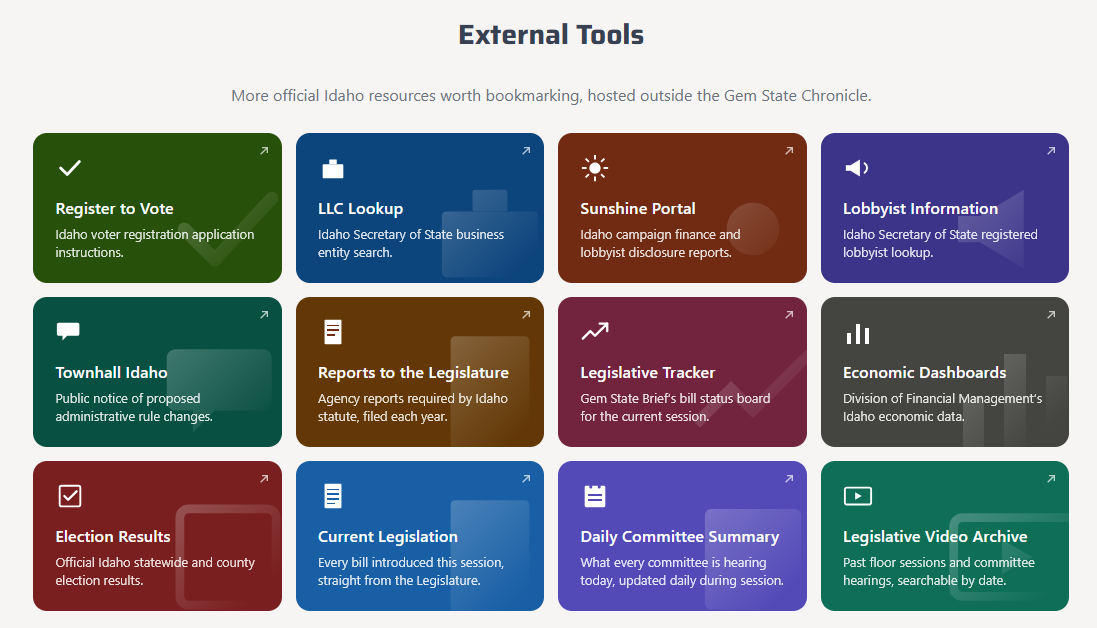
It’s still a work in progress, but I (and my AI assistant) have been refining the Idaho Insider hub page today. With all the work I’ve done on other pages it seemed a shame to let it remain so boring and pedestrian. As of now it has links not only to pages covering the three branches of government, but multiple resources within the Gem State Chronicle as well as links to useful tools elsewhere as well.
As always, thank you to sponsors Lynn Bradescu’s Boise Realty, Money Metals, and New Saint Andrews College. Thank you also to all the paid subscribers who make it possible for me to do what I do, as well as all the readers who are constantly encouraging me to keep it up. I appreciate you!
I moved to Idaho from Silicon Valley in 2020. I wanted to get away from the hard left environment supported and promoted by Big Tech companies among others. Imagine how horrified I was when I learned that META is now on the board of IACI. I’m concerned for Idaho’s future.
I suspect part of the divergence in views between the business community as represented by IACI and conservatives as represented by IFF is that IAFC has extended its scope of interest to matters arguably not even indirectly related to commerce. A quick glance at the IACI scorecard shows it opposing three bills right off the bat:
H 0542 Adds to existing law to establish the Stop Harms from Addictive Social Media Act …oppose
H 0572 Adds to existing law to establish the Pediatric Secretive Transitions Parental Rights Act…oppose
H 0574 Amends, repeals, and adds to existing law to establish provisions regarding medical mandates... oppose
Regardless of one’s view of these bills, the business community has no legitimate reason involving itself in these matters. This is a big problem.
It would be interesting to look at the bills IACI scored that actually relate to strengthening the Idaho economy and compare those scores with IFF's scores.


I moved to Idaho from Silicon Valley in 2020. I wanted to get away from the hard left environment supported and promoted by Big Tech companies among others. Imagine how horrified I was when I learned that META is now on the board of IACI. I’m concerned for Idaho’s future.
Brian,
Great work!
I suspect part of the divergence in views between the business community as represented by IACI and conservatives as represented by IFF is that IAFC has extended its scope of interest to matters arguably not even indirectly related to commerce. A quick glance at the IACI scorecard shows it opposing three bills right off the bat:
H 0542 Adds to existing law to establish the Stop Harms from Addictive Social Media Act …oppose
H 0572 Adds to existing law to establish the Pediatric Secretive Transitions Parental Rights Act…oppose
H 0574 Amends, repeals, and adds to existing law to establish provisions regarding medical mandates... oppose
Regardless of one’s view of these bills, the business community has no legitimate reason involving itself in these matters. This is a big problem.
It would be interesting to look at the bills IACI scored that actually relate to strengthening the Idaho economy and compare those scores with IFF's scores.