

What is truth?
I think it’s fair to say that most Christians and conservatives don’t believe in relative truth. We believe that some things are true, and some things are false. Yet recognizing the difference is becoming harder and harder, despite—or perhaps because of—the flood of information at our fingertips.
I used to believe that, had the internet, social media, and smartphones been around in 1963, there would be no question as to who shot President John Kennedy. Yet Charlie Kirk was assassinated in front of hundreds of people, with numerous video streams recording the event, and there is nevertheless a thriving ecosystem of podcasters and influencers whose audiences will believe the most absurd theories while dismissing the most obvious explanation as “fedslop.”
Over the weekend, the internet was full of women concocting fantastical alternative explanations regarding the story of a woman who murdered her three children. I saw many examples of women projecting their own feelings about men, children, postpartum depression, and the healthcare industry in general onto this case, then using those feelings as a basis for their opinions about the facts.
Neither side of the aisle is immune to this. Democratic politicians still promote lies about the deaths of Michael Brown and Trayvon Martin, and about President Trump and Russia. People on all sides seem to believe that the lesson of the Epstein situation is that all their political enemies are pedophiles.
Despite—or perhaps because of—instantaneous access to the sum total of human knowledge, combined with the dopamine cycle generated by social media, we’ve lost the ability to discern the truth. We can adopt the most ridiculous positions and then find an online community that validates them. We can shut out opposing viewpoints until we live in a bubble that creates a cycle of reinforcement.
Conservatives have developed a well-earned distrust of the government over the past few decades. Incidents like Ruby Ridge and Waco, the buildup to the Iraq War, and the 2020 presidential election each damaged our confidence in our government’s willingness to be honest and transparent with the American people. Yet it was Covid-19 that destroyed the last shred of credibility for millions of Americans. A virus that, for many people, was little more than a bad flu was treated like the Black Plague, and our leaders responded by shutting down society, closing schools, churches, and businesses, prohibiting people from visiting their loved ones, and arresting people for the crime of being outdoors—all while they themselves ignored the rules they set for others. Remember Dr. Birx visiting her family for Thanksgiving while telling us we must stay home, or California governor Gavin Newsom having a fancy dinner with his wealthy friends after shutting down churches in his state.
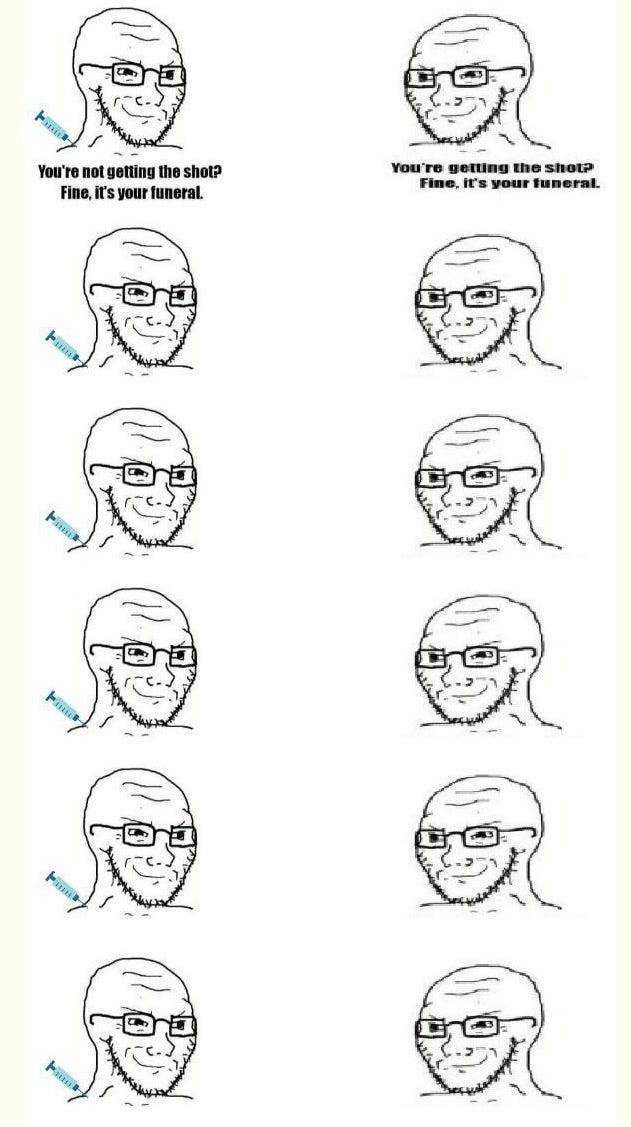
Yet at the same time that we lost trust in the government and so-called official sources, I think we became too credulous toward a lunatic fringe. We overcorrected. We scrambled to find brave truth-tellers who weren’t bought or controlled, and in doing so, we lost a sense of discernment. Even during the rollout of the COVID-19 vaccines, it seemed like the country was divided into two distinct groups: one that believed the vaccine was a miracle drug that was not only “safe and effective” but would prevent 100% of infections, and the other that believed anyone taking the shot would be dead within two years.
Charting a middle route between those two extreme positions only resulted in being denounced by both sides. I still have a meme from that era that sums up what it was like for those of us who didn’t fall into either camp:
How we understand truth is foundational to our politics. We advocate for policies based upon what we believe to be true about the world. But if we’re stuck in some bubble that has drifted away from reality, then our politics will drift away as well. This has enormous implications for the decisions we and our elected leaders will make over the coming years—decisions regarding taxes, data centers, automated license plate readers, crime and punishment, and more.
The first step toward truly learning the truth is being willing to challenge your own preconceptions. Take the things you believe and subject them to the same standards of evidence you would demand for your opponents. Step outside your bubble and read different perspectives on issues that you feel strongly about. Find the strongest argument against your position and see if you can overcome it. You will either strengthen your existing position, or recognize its shortcomings and get one step closer to the truth. Either way, you are stronger for it.
Beware of those who take absolutist positions on most issues—claiming that their ideas have no downsides or that opposing ideas have no upsides. Remember Thomas Sowell’s maxim that there are no solutions, only tradeoffs. Be willing to discuss and debate the tradeoffs inherent in any issue.
Above all, resist the temptation to adopt your positions as part of your identity. It’s too easy to take debate personally when we make our political beliefs a core part of who we are. Practice the ability to examine an idea without necessarily adopting it. Hold it up to the light, subject it to stress, and see if it withstands all you can put against it.
Truth is perhaps the most important thing in politics, but it’s often the first casualty when our political debates turn into online flame wars.
Feature image “Ecce Homo” by Antonio Ciseri, 1880
The Simpson Standard
Congressman Mike Simpson published his weekly newsletter yesterday:
Deadly wildfires are continuously impacting communities throughout the West. My colleagues in both the House and Senate are grateful to the Department of Agriculture Secretary Rollins and the Department of the Interior Secretary Burgum for coming to Boise’s National Interagency Fire Center, the nation’s support and information center for wildland firefighting, and for taking the time to visit the Claremont Fire site.
I was excited to spend the week in Idaho’s Second District and celebrate the ribbon-cutting ceremony for the LeRoy Craig Jerome Center at the College of Southern Idaho, a community funding project that I am proud to have secured funding for.
Last but not least, I enjoyed meeting with constituents, including Idaho’s dairy farmers earlier this week and discussing some of our shared priorities.
Back to school
Sen. Tammy Nichols published an informative post about new laws in effect for the new school year:

Video of the day
Rufo & Lomez had a fascinating discussion with paleoconservative Paul Gottfried about the evolution of the left in America and Europe. It’s gone beyond communism now:
Remember to check out all the tools at Idaho Insider, including the brand new Budget Calculator.
Once again, a big thank you to sponsors Lynn Bradescu’s Boise Realty, Money Metals, and New Saint Andrews College. Thank you also to all the paid subscribers who make it possible for me to do what I do, as well as all the readers who are constantly encouraging me to keep it up. I appreciate you!
At least on a society level, erring on the side of Conspiracy Theory is the better approach than defaulting toward the Official Narrative. It'll mean that the burden of proof is with the authorities to enact their policies, since they rarely use "the science" to remove coercive influence.
Great application point.
"Above all, resist the temptation to adopt your positions as part of your identity. It’s too easy to take debate personally when we make our political beliefs a core part of who we are. Practice the ability to examine an idea without necessarily adopting it. Hold it up to the light, subject it to stress, and see if it withstands all you can put against it."