

I’ve been rereading the Federalist Papers before bed each night, and I was recently struck by how hard Alexander Hamilton and James Madison worked to explain why the new Constitution created a bicameral Congress—that is, one in which the legislative branch was divided into two chambers.
While the British system used a bicameral legislature—the House of Lords and the House of Commons—it wasn’t necessarily obvious that the new United States of America should do the same. Our founders took a great deal of inspiration from the Greek and Roman republics, which tended to be unicameral, with a single representative assembly. On the other hand, while the British Parliament was bicameral, the upper chamber—the House of Lords—was composed of hereditary peers, something the American people found distasteful.
Yet America was different from its mother country in other ways as well. The United States was just that—thirteen semi-sovereign states attempting to come together to form a national government that could act on behalf of the states in matters of international commerce and diplomacy. How could the framers of the Constitution allow the states to maintain control over that government while still giving voice to the people?
The answer was a bicameral legislature. The House of Representatives would consist of men elected by voters in their regions, with the number of seats apportioned by population. The Senate, on the other hand, would consist of two men from each state, appointed by the legislatures of those states. In this way, Congress would represent both the people at large and the states as semi-sovereign entities.
Each chamber had unique functions related to its composition. The House, directly representing the people, held the power of the purse. All bills related to taxation would originate in that chamber, and representatives would have the ability to control how the national government was funded. Madison pointed to this as an important check by the people on the government in Federalist No. 58.
The Senate, by contrast, would be concerned with other matters, such as ratifying treaties with foreign nations and confirming the president’s appointments to cabinet positions and the judiciary. This gave the states tremendous influence over the form of the federal government.
Of course, the passage of the 17th Amendment in 1913, mandating that senators be directly elected by the people, changed that paradigm completely. The Senate retains its functions, but its connection to the states as semi-sovereign entities has been severed.
Madison explained the reason for these differences in Federalist No. 51, saying that since no external force could keep the government in check, it must therefore be constructed in such a way that each interior department checked the other.
So what does this have to do with Idaho? The framers of our state constitution mirrored our legislative branch after the federal government. Originally, our Senate represented counties, while our House represented subsections of those counties. This changed after an 8–1 decision by the U.S. Supreme Court in 1964, which ruled that state legislatures must represent people, not geography. I wrote a long essay about that case and its implications for Idaho last year.
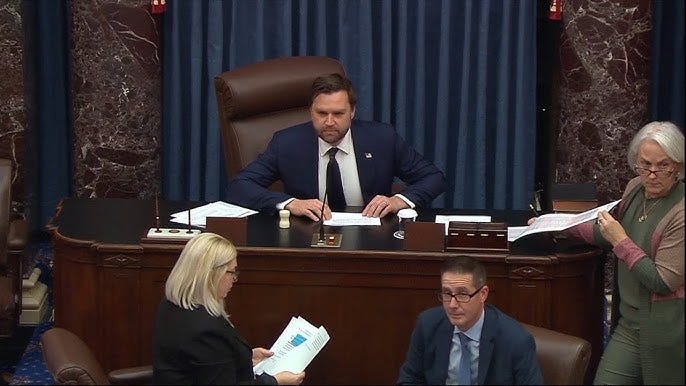
The way we copied the federal system extends even to the role of the lieutenant governor, who—though nominally part of the executive branch and directly elected every four years—presides over the State Senate, following the example of the vice president in the United States Senate. However, while Vice President J.D. Vance, following long tradition, largely delegates his role as President of the Senate except when needed to break a tie vote, Lt. Gov. Scott Bedke can be found presiding over the Idaho Senate nearly every day.
Today, Idaho is divided into 35 districts of approximately 52,500 people each. Each district elects one senator and two representatives, resulting in a Legislature composed of 35 senators and 70 representatives. Following the federal model, Idaho’s Constitution requires tax bills to originate in the House, while the Senate confirms the governor’s appointments.
Each chamber adopts its own rules, so procedures differ slightly depending on which side of the rotunda you’re on. The House votes electronically, for example, while the Senate secretary calls the roll for each motion or bill. In Senate committees, motions require a second, while House committees proceed without one.
I’ve talked to some legislators over the past few months who would like to see a greater distinction in duties between the two chambers. There was a bill draft last year to bring confirmation of state university presidents under the purview of the Senate, and I’ve also heard some discussion about getting the House more involved in the initiative process.
While I don’t expect the Supreme Court to allow us to return to one senator per county anytime soon, there may be other ways to improve representation. One idea I’ve heard—most notably from former state senator Branden Durst—is to divide districts into subdistricts of equal population. Right now, every voter in each district selects a candidate for both House Seat A and House Seat B. What if half the voters selected Seat A and the other half selected Seat B? This would mean each state representative would answer to half the number of citizens they currently do—roughly 26,250—and it would further distinguish the House from the Senate.
Many senators I’ve spoken with over the past few years take pride in what they see as their role in slowing down legislation and making time for deliberation. Indeed, a common complaint among Idaho conservatives is that the Senate is where good bills go to die. Being the slower, more deliberate body can be either a blessing or a curse.
As you watch the Legislature this year, keep an eye on the distinctions between the chambers. Personally, I think the House looks like the most fun. What do you think? Check out the Legislative Branch page at Idaho Insider to learn more about legislative districts, committees, and the men and women who represent you in the Idaho House and Senate.
Another great article Brian. We forget how much we forget! Also, the Idaho Republican Platform has called for the repeal of the 17th Amendment, which I support, and you have done a great job explaining that. No, we don't want to "take away your vote", we just want to return to the original purpose and structure of the Senate.