

On Friday morning, I watched testimony in House State Affairs regarding Senate Bill 1300, which would make the directors of the Idaho Department of Transportation (ITD), Idaho Fish and Game (IDFG), and the Department of Parks and Recreation (DPR) appointed by the governor and confirmed by the Senate. Currently, these three directors serve at the pleasure of unelected boards.
The Idaho Transportation Board is made up of seven members appointed by the governor, six of whom represent the six ITD districts across the state. According to its website, the board "establishes state transportation policy and guides the planning, development and management of a transportation network that is safe and efficient."
The Fish and Game Commission was established via citizen's initiative in 1938 and is made up of seven appointees representing separate districts, with a maximum of four being from a single political party. Its duties are to "supervise the Department of Fish and Game; establish regulations and other needed controls on fishing, hunting, trapping and management of wildlife in line with the state's wildlife policy; approve department budgets for submission to the legislature; hold public hearings and make decisions on the management of the state's wildlife."
Finally, the Idaho Park and Recreation Board is made up of six members appointed by the governor, each representing a separate geographical district in the state. No more than three members can be from the same political party.
S1300 passed the Senate 21-14 earlier this month on a mostly conservative/liberal divide, with a few exceptions.

Sen. Doug Okuniewicz presented the bill in the House State Affairs Committee on Friday morning where members debated for more than an hour before passing on a narrow 8-6 vote. Watch the whole thing if you have the time:
Opponents claimed that making directors appointed by the governor would politicize these supposedly non-political agencies. Reps. Heather Scott and Joe Alfieri pushed back, saying that everything is political today. Left unstated during questioning by Democratic Reps. Monica Church and Anne Haws was the fact that each of these boards requires balance between political parties, so Democrats currently have outsized influence on these agencies.
One opponent, Nick Fasciano, executive director of the Idaho Wildlife Federation, said he was worried about a political appointee eroding hunting rights in Idaho. Rep. Judy Boyle pressed him on that, not only confirming that the right to hunt and fish was protected by the Idaho Constitution, but noting that Fasciano himself had just testified in support of a rule to constrain those rights in another committee a day earlier. Fasciano declined to answer Boyle's charge.
Another opponent was Matt Borg of the Eastern Idaho Houndsmen, who has served on IDFG working groups. His concern was that a future administration might appoint radical environmentalists who would restrict hunting, fishing, and recreation.
One of the most discussed issues during the hearing was Harriman State Park. Railroad magnate Edward Harriman purchased the land in 1908, and his heirs donated it to the people of Idaho in 1961. The agreement signed by Gov. Bob Smylie included a clause that the Legislature would establish a "professionally staffed career Park Service whose personnel shall be chosen on the basis of merit alone, which shall be administered under merit system procedures for personnel administration."
This agreement laid the foundation for the Idaho Department of Parks and Recreation. At Sen. Okuniewicz's request, Legislative Services Office (LSO) legal analyst Elizabeth Bowen drafted an opinion concluding that S1300 would not violate it. The short answer, she wrote, is that:
There is no inherent conflict between S.B. 1300 and the conveyance instruments. While the conveyance instruments require the merit-based selection of department personnel, the selection process itself is left to the discretion of the Legislature. As long as the director is appointed on the basis of merit, the State is in compliance with the conveyance instruments.
However, several testifiers disagreed.
Charlie Lansche, a member of the Friends of Harriman State Park, said that his organization had already retained Cathy Silak of the Hawley Troxell law firm, who disagreed with Bowen's position. He warned that proceeding with S1300 would lead to costly litigation—a not-so-veiled threat against the Legislature.
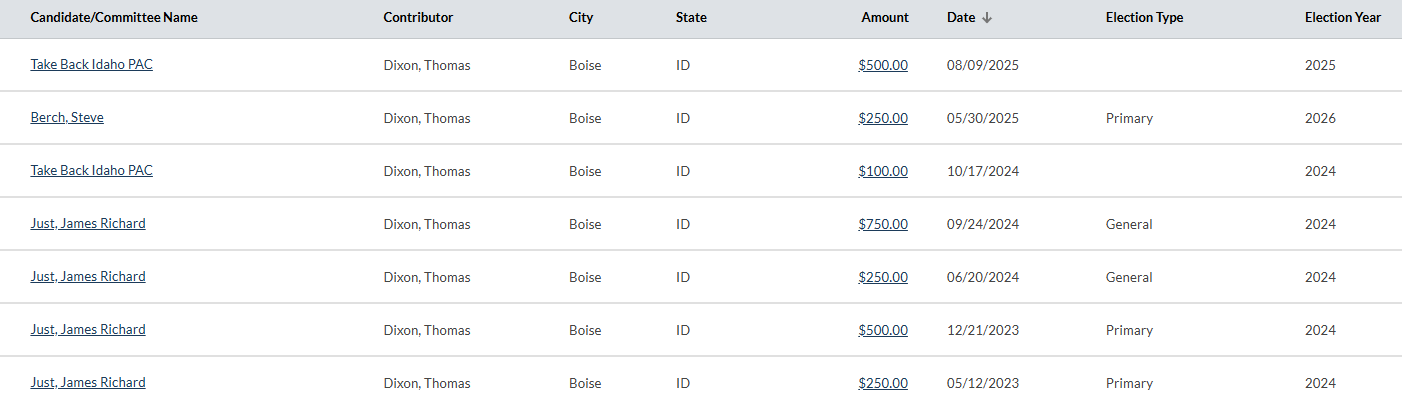
Thomas Dixon, a grandson of Roland Harriman, testified in opposition to the bill, stating that allowing the governor to appoint the director of DPR would violate both the agreement and the spirit of the Harrimans' gift to Idaho. Dixon himself appears to have a partisan perspective, however, as Idaho Sunshine shows that he has donated exclusively to Democrats over the last two years, as well as the left-wing Take Back Idaho PAC.
Attorney Silak also appears to have a partisan position, judging from her donations to Democratic Rep. Monica Church—who sits on the House State Affairs Committee and debated against the bill—as well as the Democratic Legislative Campaign Committee.

The heart of the question has to do with the very foundation of our republican system of government. The separation of powers created by our federal and state constitutions, based on the philosophy of Montesquieu and others, means that each branch of government is responsible for its own sphere of influence and accountable in some way to the people, from whom sovereignty derives.
Idaho Freedom Foundation touched upon this issue in its analysis of S1300:
Without the ability to hire and fire his subordinates, the executive cannot be fully in control of the execution of the laws and this imperils his oath to faithfully execute the laws.
This presents numerous problems beyond the most obvious problem of what the remedy is for an insubordinate official. It also obscures responsibility and transparency, as blame is easily shifted away from the head executive because they did not appoint the department head. It divides the executive against itself, eating away at its core duty: a stable and continuous execution of the laws. The executive must be able to appoint (with advice and consent of the Senate) as well as remove agency heads to maintain the separation of powers.
The governing boards of these three agencies are already appointed by the governor, so why should the directors not be? Sen. Okuniewicz related a story from his freshman term in the House where legislators debated a bill related to bowhunting. Lobbyists from IDFG told legislators that the decision should lie with them—the bureaucrats—rather than the people's representatives.
Okuniewicz said this bill was about bringing Idaho government further under the oversight of Idaho's elected lawmakers. "We set policy, they implement it," he said.
I broke down Okuniewicz’s presentation with Matt Edwards on Idaho Signal on Friday:
I've long been writing about how American government has been moving in a more technocratic direction over the past century. Politics can be messy, so isn't it better—so the bureaucrats argue—to take elected officials out of the equation and let experts do what's best? The Pendleton Civil Service Reform Act of 1883 moved many federal positions outside the purview of the president, then the New Deal of the 1930s and the Great Society of the 1960s massively expanded that same federal government. The last decade has been the story of Donald Trump, the duly elected President of the United States, fighting an entrenched bureaucracy vehemently opposed to his—and our—interests.
I asked on X what people thought of S1300. Some liked the idea of reducing the influence of unelected bureaucrats and political appointees. Others worried that these directorial positions would become overly politicized, especially if we ever see another Democratic governor.
During the House committee debate, Rep. Stephanie Mickelsen expressed concern that moving the authority to hire and fire directors of these agencies from boards to the governor could make the boards themselves obsolete. Maybe she's right. Earlier this week, Gov. Brad Little signed Senate Bill 1314 into law, sunsetting the Idaho Board of Health and Welfare. The rationale given in the bill's statement of purpose is that the Legislature has taken on increased oversight of the Department of Health and Welfare in recent years.
Will the boards of ITD, IDFG, and DPR face the same result in the coming years?
Not necessarily. I have some direct personal experience I can bring to this conversation. The Eagle Public Library is a municipal library, meaning it is a division of the city rather than an independent taxing district. Independent library districts have trustees elected by voters, and those trustees have plenary power over the library — they can hire and fire library directors, set budgets, and even propose bonds and levies.
Municipal libraries are different, since they exist underneath cities. I was appointed as a trustee by then-Eagle Mayor Jason Pierce and confirmed by the city council. There was, however, a quirk in both Idaho law and our city code: the board was responsible for hiring and firing the library director.
Earlier this month, Rep. Jeff Cornilles introduced House Bill 715, which would make clear that city councils have ultimate authority regarding hiring or firing library directors. I offered testimony to the Senate Local Government & Taxation Committee while maintaining a neutral stance, simply to let the record show that the Eagle Library Board currently has a great relationship with both our director and our city council.
In talking with Rep. Cornilles, I came to realize that the current situation really was incongruous. Municipal library directors are city employees, which means the city's elected leaders should have the final say. Municipal library boards still have roles to play in providing regular oversight and setting library policies, but when it comes to the budget and the director, we work with our city council.
I generally support moves that bring our government back into alignment with the republican system our founders envisioned. S1300 seems to do just that, bringing the authority to appoint directors of taxpayer-funded government agencies to the governor, who we elect as chief executive of the state.
Consider the Estella Zamora incident a few months ago. We learned that a longtime member of the Idaho Human Rights Commission was posting anti-ICE, anti-Trump, and anti-conservative messages on social media—messages that went beyond mere opinion, as she advocated resistance to federal law enforcement. It was not a good look for someone with the job of adjudicating civil rights disputes.
Many of you wrote letters and emails to Gov. Little as well as Senate President Pro Tempore Kelly Anthon, and they responded by pulling her nomination. Consider that: our elected leaders listened to the people. Had Zamora served at the pleasure of an unelected board, I doubt we could have had nearly as much influence.
I see S1300 as a step back toward the republican ideal bequeathed by our founders and away from the technocratic oligarchy that has crept into our nation over the past century. I look forward to seeing it further debated on the House floor as the session winds down next week.
Feature image created with Microsoft Copilot.
Thank you for being a watchdog on our government, and reporting to Us the People.