

On Monday afternoon, I watched nearly 90 minutes of discussion and debate regarding House Bill 513 in the House Business Committee. You can catch the highlights with my live thread or watch the entire hearing below.
It was a very educational experience. The world of cosmetology is one of which I am blissfully ignorant, but for those who make their living as cosmetologists and cosmetology teachers, it is all-consuming. Even when I had a full head of hair, I visited a basic neighborhood barber, while professionals in this field deal with haircuts, makeup, skincare, nails, and more. Cosmetology is one of many fields regulated under the Division of Occupational Licensing (DOPL), which requires both coursework and passage of an exam before someone is allowed to perform these services.
The bill, sponsored by Rep. Jeff Ehlers, would reduce the number of hours required for a cosmetology license from 1,600 to 1,000. Ehlers said several other states have already taken that step without any impact on service quality. He presented a new draft that moved the effective date from July 1, 2026, to January 1, 2027, allowing more time for schools and instructors to adjust.
Ehlers yielded some of his time to Alyssa Bowman of Star, a franchise owner with Sport Clips who operates 25 stores in the region. She said the bill expands opportunities for students, lowers barriers to entry, preserves public safety by maintaining competency requirements, and supports employers and small businesses.
However, several cosmetologists, cosmetology business owners, and cosmetology school operators testified against the bill, arguing that the current number of required hours is necessary to ensure customers receive safe and high-quality service. They pointed to Sport Clips, which does not handle skin or nails, as going outside of its lane in supporting this rule change. Some even warned that reducing the hours required for licensure could put customers at risk of chemical burns from unqualified providers.
There was some pushback on that position. Rep. Brent Crane pointed out that his teenage daughter uses a variety of over-the-counter chemical products to style and color her hair and has never injured herself. Kayli O’Neal, a Sport Clips manager, testified in favor of the bill, saying the current requirements impose a high burden on incoming students. She added that she has seen no difference in quality between students trained in Texas under a 1,000-hour requirement and those trained in Idaho under the 1,600-hour standard.
Rep. Rick Cheatum spoke in opposition to the bill, saying he would defer to the experts, while Rep. Steve Berch said he had received 25 emails from constituents, all opposed to reducing licensure requirements. Both men voted against the motion to send the bill to the House floor with a recommendation that it pass.
During his presentation, Rep. Ehlers pointed out that cosmetology licensure requires more training than becoming a police officer. Ron Nate, president of the Idaho Freedom Foundation, testified in favor of the bill, saying that while it is a good step, he would prefer full deregulation. Rep. Brent Crane agreed, asking why state government is involved in licensing cosmetologists at all. He indicated he would support a bill eliminating licensure entirely if one were introduced.
That is the central question here, isn’t it? Is it within the proper scope of state government to require a certain amount of training, plus passage of a test, in order to practice cosmetology? If the requirement disappeared tomorrow, salon owners could still require licensure from their employees. If an unlicensed cosmetologist were to set up shop and ruin someone’s haircut, they would presumably not get much business in the future. As Rep. Crane pointed out, a bad haircut can be fixed in two weeks.
What about the risk of chemical burns? Crane asked how often these occur—if they were common, he said, one would expect class-action lawsuits against the manufacturers.
Another point raised in opposition to the bill came from Joseph Starita, president of the Paul Mitchell cosmetology school in Boise. He suggested that federal aid for cosmetology students is tied to hours spent in school, and that reducing the required hours could reduce the amount of federal aid available. Of course, it goes without saying that someone who runs a cosmetology school would support regulations requiring students to spend more time—and money—at his institution.
Many jobs in Idaho require a license from the government. Below is a screenshot from the Division of Occupational Licensing (DOPL) website, which oversees those licenses:
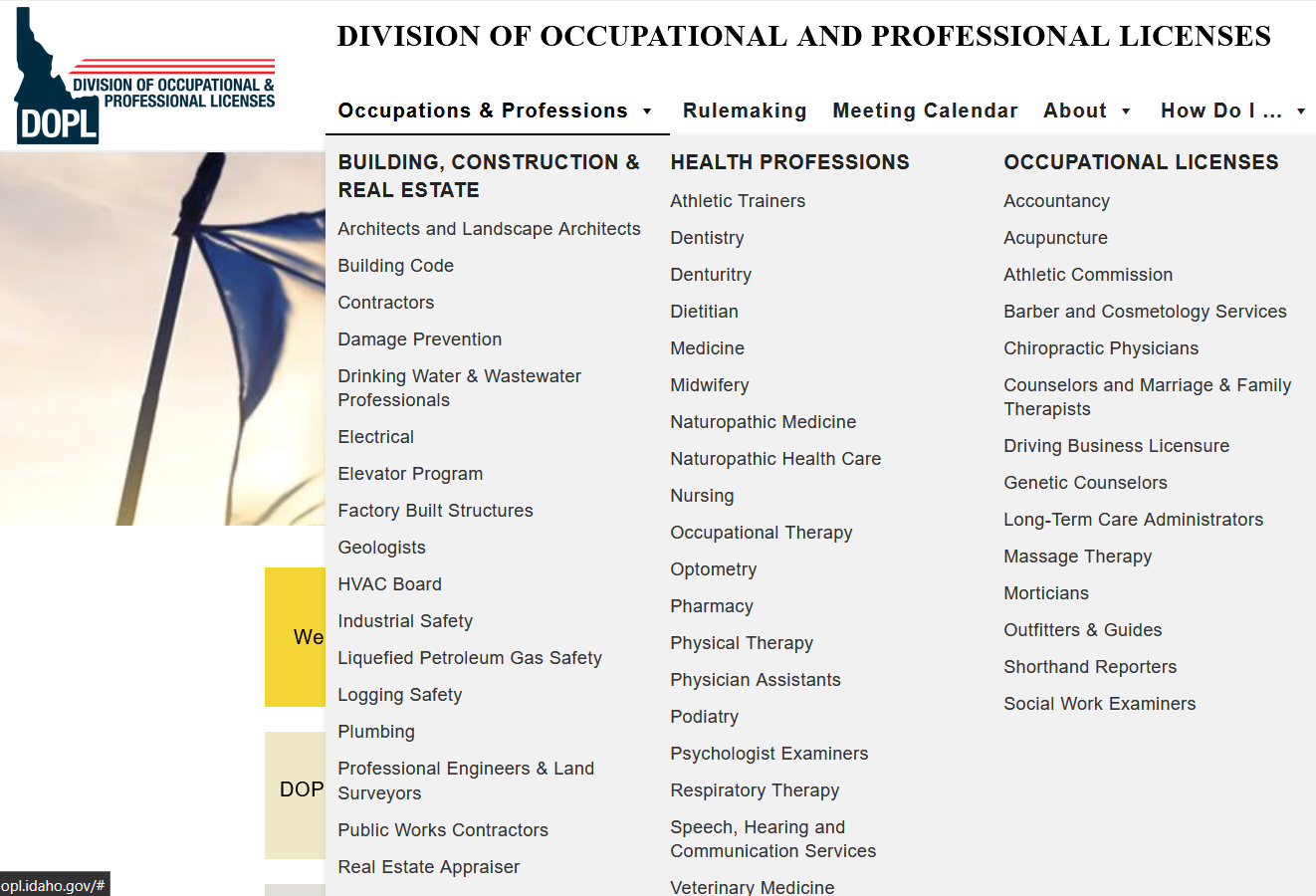
Where should the state draw the line? Are there industries that need a government board to set standards and ensure practitioners meet a minimum level of competency? If so, which ones?
In his testimony, Ron Nate argued that government-issued licenses give consumers a false sense of security. There is no guarantee that a licensed cosmetologist will not give a bad haircut or cause damage with a dye job gone wrong.
DOPL regulations form a complex maze of state code and administrative rules. Licensure may be a dry topic, but few areas of state government more directly affect our daily lives. Perhaps there is room for licensure requirements in certain industries—we can have that conversation. Reducing cosmetology training requirements to match those of seven other states seems like an easy win for both consumers and practitioners.
Feature image created with Microsoft Copilot.